
| Quick answerSearching for free SexArt movies does not automatically mean that every “free” result is authorized or safe. The lowest-risk approach is to use clearly legitimate services, treat official previews and licensed promotions differently from unauthorized full-copy pages, and avoid sites that rely on forced downloads, deceptive redirects, or unclear payment requests. |
The phrase free sexart movies is a high-intent search. In practice, people may be looking for a free preview, a legitimate promotion, a sample clip, information about a subscription, or a full movie without payment. Those are not the same thing from a licensing or safety perspective.
A useful page should answer that intent without pretending an unauthorized copy is legitimate. That people-first approach is also consistent with Google Search Central’s guidance on helpful, reliable content, which emphasizes clear sourcing, genuine usefulness, and content created primarily for people rather than to manipulate rankings.
Can SexArt Movies Be Watched for Free Legally?
Sometimes adult entertainment publishers or licensed platforms may make selected previews, trailers, promotional material, or limited samples available without a full paid subscription. That is fundamentally different from a third-party page redistributing a complete copyrighted work without permission.
Because offers change, do not assume that a search result promising “free full movies” is an official offer. Verify the publisher or platform, read its current terms, and look for transparent information about what is free, what requires registration, and what is included in a paid plan. This article does not provide pirated copies, mirror links, torrents, or methods for bypassing paywalls.
Free preview vs. unauthorized copy
- Official preview: material intentionally made available by the rights holder or an authorized distributor.
- Licensed promotion: temporary or limited access provided under stated terms.
- Unauthorized copy: a full or substantial copy posted by a third party without clear permission.
- Misleading “free” page: a page using the promise of free access mainly to trigger redirects, sign-ups, downloads, or payment prompts.
Why Unofficial “Free Streaming” Pages Can Be Risky
Risk is not limited to copyright questions. Some deceptive pages use familiar movie-streaming language to push visitors toward unrelated downloads, browser-notification permissions, fake verification steps, or payment forms. Google’s spam policies specifically describe malicious practices that create a mismatch between what a user expects and what actually happens, including malware, unwanted software, deceptive redirects, scams, and compromised privacy.
1. Fake play and download buttons
A suspicious page may present several large “Play” or “Download” buttons that do not start a video at all. Instead, they may open ads, redirect to unrelated domains, or prompt an executable or browser extension. A legitimate streaming page should not need an unknown installer simply to play a web video.
2. Aggressive redirects and pop-ups
One unexpected redirect can be an ad. Repeated redirects, rapidly opening tabs, or a page that sends you to a completely different service are stronger warning signs. Google explicitly identifies sneaky redirects as a deceptive practice when users are sent somewhere that does not fulfill the original need.
3. Phishing and payment traps
A “free” page that suddenly claims your account, card, or identity must be verified deserves extra caution. The U.S. Federal Trade Commission’s phishing guidance notes that scammers often use convincing stories and familiar brands to push people into clicking links or surrendering passwords, account details, or financial information.
4. Privacy leakage
Adult-content browsing is especially sensitive because the browsing topic itself can be private. Treat personal details, reused passwords, notification permissions, and payment data carefully. The FTC’s online privacy and security resources provide practical guidance on protecting personal information and recognizing attempts to steal it.
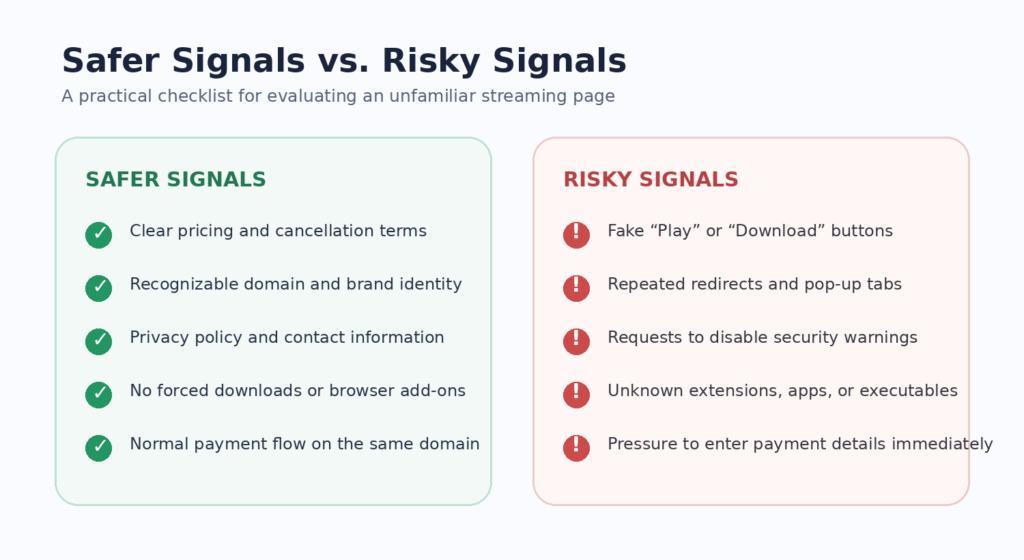
Figure 2. Original editorial checklist: signals that can help distinguish a normal service from a deceptive page.
How to Evaluate a Streaming Page Before You Trust It
No single sign proves that a site is safe, but several checks together can reduce risk. Use the following sequence before creating an account or entering payment details.
- Check the domain carefully. Look for misspellings, added words, strange subdomains, or a domain that does not match the service name shown on the page.
- Read the pricing and cancellation terms. A legitimate paid service should make recurring charges, trial conditions, and cancellation rules understandable before payment.
- Look for a privacy policy and contact information. These pages do not guarantee legitimacy, but their absence on a site collecting sensitive data is a warning sign.
- Avoid forced software. Do not install an unknown extension, codec, app, or executable merely because a page claims it is required to stream.
- Treat urgent verification demands skeptically. Pressure such as “verify now or lose access” is a common social-engineering pattern.
- Confirm the destination before paying. Make sure the payment page remains on the expected service or a clearly identified payment processor.
A Privacy Checklist for Adult-Content Browsing
Privacy tools can reduce some exposure, but they do not turn an untrustworthy site into a trustworthy one. The most important protection is still choosing where you browse and what information you give away.
- Keep your browser, operating system, and security software updated.
- Use unique passwords; do not reuse a primary email or banking password on an unfamiliar entertainment site.
- Review browser-notification requests instead of clicking Allow automatically.
- Do not upload identity documents or payment details to a site whose ownership and purpose you cannot verify.
- Close suspicious tabs rather than interacting with alarming pop-ups that claim your device is infected.
- If a message or page asks you to click a link to “fix” an account problem, navigate to the service independently instead of trusting the supplied link.
The FTC similarly advises people to avoid unexpected links and instead contact a company through a phone number or website they already know is real when they suspect an attempt to steal personal information. See FTC guidance on protecting personal information.
How Google Handles Explicit Content in Search
Adult content can appear in Google Search, but it is handled differently from ordinary entertainment content. Google’s explicit-content guidelines explain that SafeSearch is designed to filter or reduce exposure to explicit sexual content, nudity, sex-oriented services, and links to pages containing explicit material. Google uses signals from text, images, videos, and links to help classify this content.
For publishers, that means a page should accurately represent what it contains rather than using misleading thumbnails, hidden text, or unrelated keywords. Google’s image SEO guidance also notes that SafeSearch can show, blur, or block explicit images, videos, and websites depending on user settings.
What Not to Do When Looking for “Free” Access
- Do not disable browser or antivirus warnings simply because a streaming page tells you to.
- Do not install an unknown “video player,” “codec,” extension, or desktop app from an unfamiliar domain.
- Do not reuse a password that protects your email, banking, cloud storage, or social accounts.
- Do not assume HTTPS alone proves that a site is legitimate; encryption protects the connection, not the intentions of the site operator.
- Do not treat a search-engine ranking as a guarantee that a page is licensed, safe, or trustworthy.
- Do not use pirated mirrors or access-bypass methods when a work is offered commercially by its rights holder.
Frequently Asked Questions
Are free SexArt movies legal?
It depends on who is providing them and under what license. An official preview or authorized promotion may be lawful; a third-party full copy posted without permission may not be. If the licensing status is unclear, do not assume “free” means authorized.
Is every free adult-streaming website unsafe?
No. “Free” by itself does not prove a site is malicious. The concern is the combination of unclear ownership, deceptive redirects, forced downloads, fake buttons, hidden charges, or requests for sensitive information.
Can a streaming page infect a device with malware?
A normal web page does not need to install software to play standard web video. Risk rises when a page persuades you to download an executable, extension, or attachment. The FTC warns that deceptive links can be used to deliver malware.
Does private or incognito mode make browsing anonymous?
No. Private-browsing modes mainly limit what is stored locally in that browser session. They are not a guarantee of anonymity from websites, networks, service providers, trackers, or accounts you sign into.
Does Google SafeSearch remove every explicit result?
SafeSearch is designed to filter, blur, or block explicit material depending on the setting, but automated filtering is not the same as a perfect guarantee. Google recommends accurately labeling explicit sites so its systems can categorize them appropriately.
What is the safest way to respond to a suspicious payment or verification request?
Do not use the link or pop-up that raised the concern. Close it, navigate independently to the service you intended to use, and verify the account or payment status there. If you already shared sensitive information, follow your bank, payment provider, or relevant security guidance promptly