
| Quick answerReuters reported on April 7, 2026 that U.S. Immigration and Customs Enforcement (ICE) made more than 800 arrests after receiving information from the Transportation Security Administration (TSA), which had provided data on more than 31,000 travelers. The reporting did not establish that all 800-plus arrests happened inside airports. That limitation matters, and this article keeps it separate from what the records actually show. |
The headline is striking, but the details are more important than the shorthand. A Reuters investigation published April 7, 2026 reported that ICE arrested more than 800 people after receiving tips tied to passenger information from TSA. The same investigation said TSA had provided ICE with data on more than 31,000 travelers through an arrangement involving the Secure Flight program.
The story sits at the intersection of immigration enforcement, aviation security and privacy. Secure Flight was created as a passenger-screening system designed to compare traveler information against federal watch lists and support aviation security. The controversy is not simply that government agencies possess passenger information; federal rules have long required airlines to transmit specific Secure Flight Passenger Data to TSA. The sharper question is how that information is shared and used once it reaches the government.
There is also an important factual limit that often disappears in social-media summaries: Reuters said it could not determine how many of the 800-plus arrests occurred inside airports. TSA tips can help identify when a person is traveling, but the public record cited by Reuters does not justify rewriting the figure as “800 people arrested at airports.”
Reporting basis: Reuters investigation
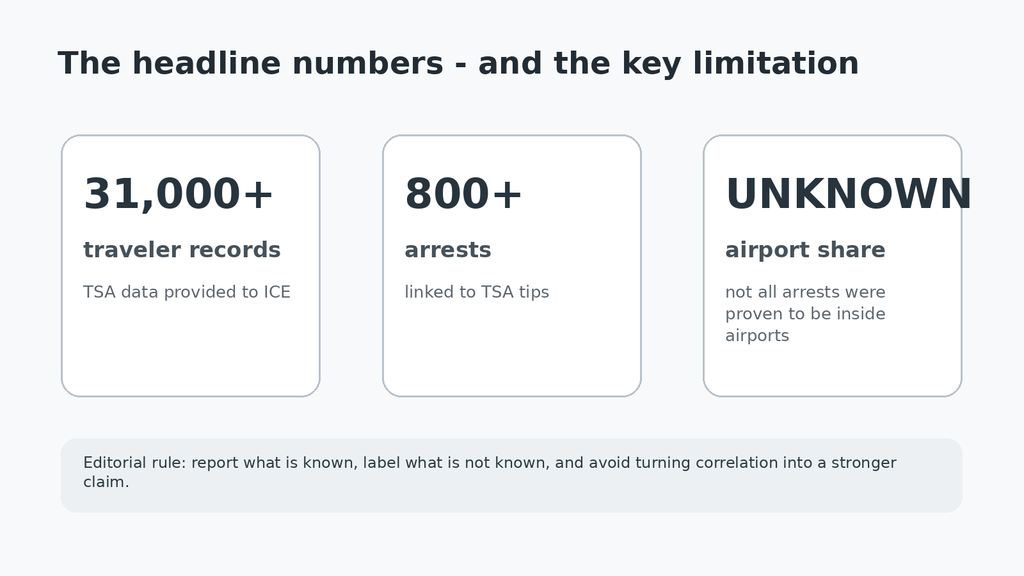
The key figures reported by Reuters, with the central limitation kept visible.
What Did the Reuters Investigation Find?
According to internal data reviewed by Reuters, more than 800 ICE arrests between the start of President Donald Trump’s current term and February 2026 were linked to information originating with TSA. Reuters also reported that TSA had provided information on more than 31,000 travelers to ICE.
That does not mean every traveler whose information was shared was arrested, nor does it mean every arrest happened at an airport. The reporting established a relationship between the tips and more than 800 arrests, while leaving the precise physical location of many arrests unresolved. For a trustworthy article, those three ideas should never be collapsed into a single, stronger claim.
Why Does TSA Have Passenger Data in the First Place?
Secure Flight is not a new immigration database. It is an aviation-security program. Federal regulation says the purpose of 49 CFR Part 1560 is to enhance air-travel security, support federal counterterrorism efforts, detect people identified on federal watch lists who seek to travel by air, and facilitate secure public travel. The regulation describes Secure Flight as TSA’s watch-list matching program.
Air carriers are required to collect core identifying information and transmit Secure Flight Passenger Data to TSA before covered flights. The data can include a traveler’s full name, date of birth and sex, along with additional fields defined in federal rules, such as passport information when available, reservation identifiers and itinerary information.
What Information Can Secure Flight Include?
- Full name, date of birth and sex.
- Redress number or Known Traveler Number when applicable.
- Passport information when available.
- Reservation control and record identifiers.
- Traveler reference and itinerary information.
The existence of these fields helps explain why passenger data can be operationally useful beyond the security checkpoint: itinerary information can reveal when travel is scheduled, while identity fields help distinguish one traveler from another. That does not by itself answer whether a particular secondary use is appropriate or lawful in a particular case; it explains why the privacy and purpose-limitation debate has become so significant.
TSA’s Own Privacy Notice Anticipates Some Law-Enforcement Sharing
Federal rules require covered aircraft operators to provide a privacy notice explaining that TSA collects passenger information for watch-list screening. The notice also says TSA may share information with law-enforcement or intelligence agencies or others under its published records rules. That language is important context: interagency sharing is not completely absent from the Secure Flight framework.
At the same time, the present controversy is about scale, purpose and implementation. A general authority to share information in defined circumstances is not the same question as how a formal TSA-ICE partnership operates, which data elements are transferred, how long information is stored, and how passenger information is used in immigration enforcement.
Required privacy notice: 49 CFR § 1560.103
Did ICE Arrest 800 People Inside Airports?
No public evidence cited in the Reuters investigation establishes that all 800-plus arrests occurred inside airports. Reuters explicitly said it could not determine how many of the arrests took place inside airports. That means headlines and social posts that turn “arrests after TSA tips” into “800 airport arrests” go beyond what the investigation proved.
Some individual airport arrests have been documented, and later reporting described an increase in immigration-related arrests at airports. But those documented cases should be treated as examples, not as proof that every arrest in the 800-plus figure happened at a TSA checkpoint or terminal.
Source: Reuters – April investigation
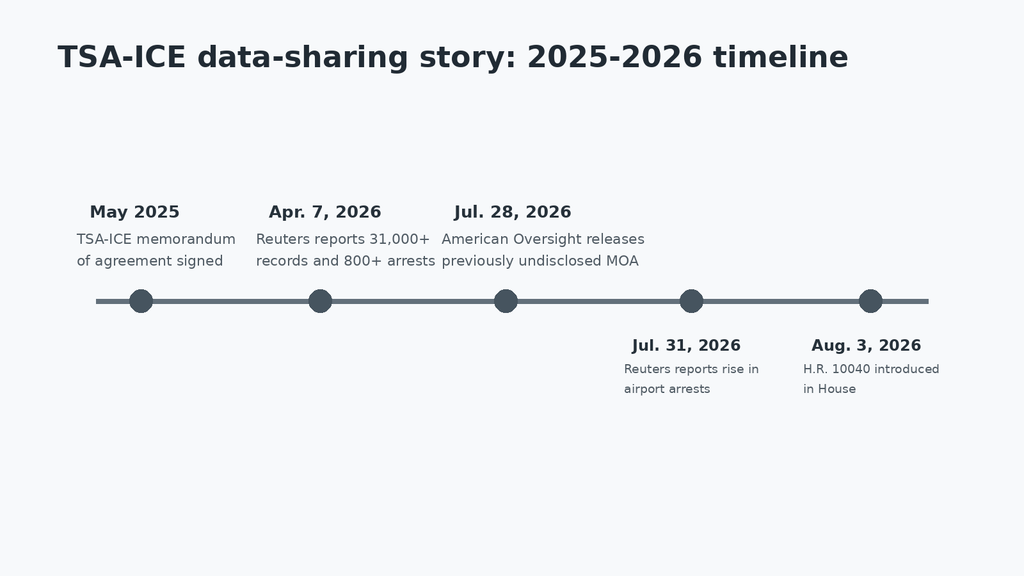
Timeline compiled from Reuters, American Oversight and U.S. Government Publishing Office records.
The TSA-ICE Agreement Revealed in July 2026
The story gained another layer on July 28, when American Oversight, a nonprofit watchdog, released a previously undisclosed Memorandum of Agreement obtained through Freedom of Information Act litigation. According to the organization, the agreement was signed in May 2025 and established procedures for how TSA and ICE would coordinate the sharing, storage and management of information.
American Oversight said the agreement cites the Secure Flight Final Rule as a legal basis for TSA’s participation and states that ICE will store information received from TSA in its own repository. The watchdog also noted that appendices identifying specific data elements were largely redacted. Because American Oversight is an advocacy and accountability organization, its characterization of the agreement should be attributed to it rather than presented as a neutral government conclusion.
Document disclosure and analysis: American Oversight – July 28, 2026
Why Congressional Testimony Became Part of the Story
The newly public agreement also intensified scrutiny of prior congressional testimony about how TSA and ICE exchange information. American Oversight argued that the wording of the memorandum appeared inconsistent with earlier descriptions that portrayed TSA as helping ICE check information rather than sending data to ICE. A January 21, 2026 House Homeland Security hearing provides the official hearing context for testimony by then-acting TSA leadership.
A careful article should avoid declaring that testimony was false unless a competent authority makes that finding. The defensible phrasing is that the released agreement raised questions about how earlier testimony should be reconciled with the formal data-sharing framework.
Official hearing page: U.S. House Committee on Homeland Security – Jan. 21, 2026
Have Airport Immigration Arrests Continued?
Yes, individual airport arrests continued to draw attention after the April investigation. On July 31, Reuters reported the detention of a Johns Hopkins researcher at an airport while she was attempting to board a domestic flight, and described a broader rise in immigration-related airport arrests. Reuters reported that DHS said her visa had expired in June 2024.
That later reporting matters because it shows airport enforcement remained a live issue months after the 31,000-record / 800-arrest investigation. It still does not retroactively convert all 800-plus cases into airport arrests; instead, it adds current context showing that airports themselves have become a more visible setting for immigration enforcement.
What Does the Government Framework Say About Identity at the Checkpoint?
TSA currently requires adult passengers to present acceptable identification at airport security checkpoints. Its public guidance lists REAL ID-compliant licenses and a range of alternatives, including U.S. and foreign passports, permanent resident cards and certain DHS-issued documents. TSA also describes an identity-verification process for some travelers who arrive without acceptable ID.
Those checkpoint rules should not be confused with immigration-status advice. Whether a traveler may face immigration enforcement depends on facts well beyond ordinary TSA identification requirements. Readers with immigration-status concerns should not rely on a general news article as a substitute for qualified legal advice.
Traveler guidance: TSA – Acceptable Identification at the TSA Checkpoint
Why Privacy and Civil-Liberties Advocates Object
The core privacy concern is purpose expansion: information provided to facilitate air travel and security screening may also become useful for a different government function. Critics argue that people disclose identifying and itinerary information because it is required to fly, creating a meaningful difference between voluntary disclosure and information that is practically unavoidable for air travelers.
Supporters of interagency cooperation can point to the broader law-enforcement sharing language in the Secure Flight privacy notice and to the government’s interest in enforcing immigration law. Critics focus on proportionality, transparency, retention, due process and whether a counterterrorism-oriented screening system should become an immigration-enforcement lead generator. Those are policy and legal questions, not facts that can be resolved by a headline alone.
The August 2026 Legislative Response
The controversy has also reached Congress. On August 3, 2026, Rep. Rashida Tlaib introduced H.R. 10040, titled the “No TSA Data for ICE Act.” The bill was referred to the House Committees on Homeland Security, the Judiciary, and Ways and Means. As introduced, it would restrict the Department of Homeland Security from using specified information to carry out certain ICE or Customs and Border Protection functions, among other provisions.
The bill is a proposal, not current law. Its introduction is nevertheless a useful indicator of how the TSA-ICE data-sharing debate has moved from investigative reporting and oversight disputes into an active legislative response.
Official bill record: GovInfo – H.R. 10040, 119th Congress
What We Know vs. What Remains Unknown
| What is established | What remains unclear / contested |
| Reuters reported 31,000+ traveler records were provided to ICE. | The public record does not reveal every data element in the TSA-ICE agreement; key appendices were redacted. |
| Reuters linked 800+ arrests to TSA tips. | Reuters could not determine how many of those arrests occurred inside airports. |
| Secure Flight is a TSA watch-list matching program with defined passenger-data fields. | The full operational scope, retention practices and implementation safeguards of the TSA-ICE arrangement are not completely public. |
| A May 2025 TSA-ICE agreement was released in July 2026 through FOIA litigation. | How the agreement should be reconciled with prior agency testimony remains disputed. |
| H.R. 10040 was introduced Aug. 3, 2026. | The bill has not become law and its future is uncertain. |
What Travelers Should Take Away
For ordinary travelers, the main takeaway is not that every airport trip triggers immigration enforcement. TSA continues to operate a mass aviation-security screening system serving millions of passengers. The important development is that reporting and released records show passenger information can also feed immigration-enforcement activity in ways that have attracted legal, political and privacy scrutiny.
Travelers should distinguish three separate questions: whether they meet TSA identification requirements, whether they have valid immigration status or unresolved immigration issues, and whether their information may be accessible to other federal agencies under applicable rules and agreements. Those questions overlap, but they are not interchangeable.
FAQ
Did TSA give traveler information to ICE?
Reuters reported that TSA provided information on more than 31,000 travelers to ICE, and a later-released 2025 memorandum described a formal TSA-ICE data-sharing framework.
How many arrests were linked to TSA tips?
Reuters reported more than 800 ICE arrests linked to TSA tips through February 2026.
Were all 800-plus arrests made at airports?
No such conclusion has been established. Reuters said it could not determine how many of the arrests occurred inside airports.
What is Secure Flight?
Secure Flight is TSA’s passenger watch-list matching program. Federal rules describe its purpose as supporting air-travel security and federal counterterrorism efforts.
What passenger data does Secure Flight use?
Federal rules define Secure Flight Passenger Data to include core identity information and, when available, fields such as passport, reservation and itinerary information.
Is TSA-ICE data sharing illegal?
This article does not make that legal conclusion. The arrangement has generated litigation, congressional scrutiny and legislative proposals, while relevant federal rules also contain law-enforcement sharing language. Specific legal questions require authoritative legal analysis.
What changed in August 2026?
H.R. 10040, the No TSA Data for ICE Act, was introduced in the House on August 3, 2026. It is a proposed bill, not enacted law.