
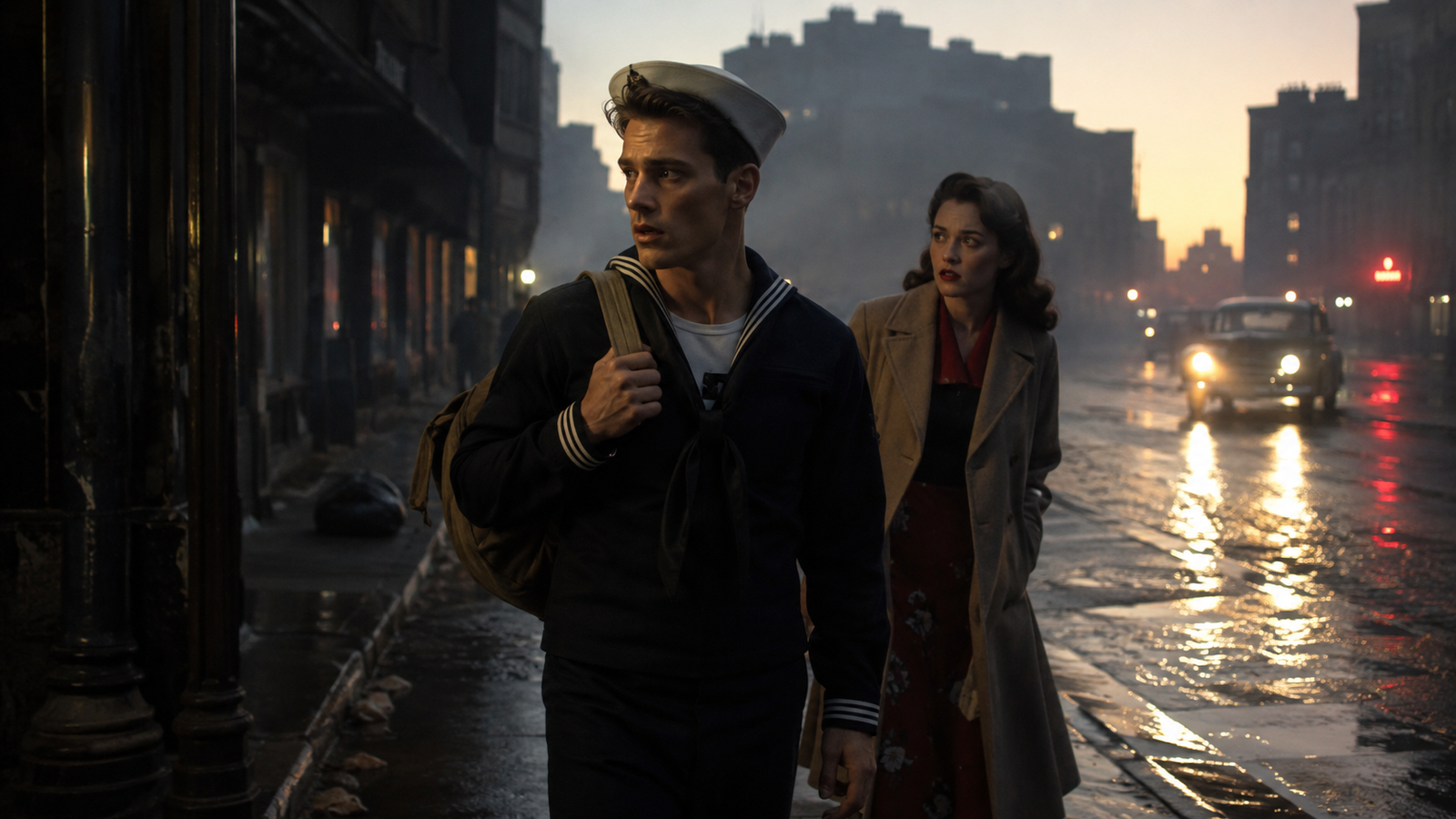
Deadline at Dawn is a compact 1946 RKO mystery that turns one confused sailor’s missing hour into an all-night race through New York City. Directed by Harold Clurman from a screenplay by Clifford Odets and based on Cornell Woolrich’s novel, the film stars Susan Hayward, Bill Williams and Paul Lukas. The setup is pure noir: money that should not be in a man’s pocket, a murdered woman, uncertain memory, a shrinking window of time and a city that seems to grow stranger as dawn approaches.
What makes the film memorable is not simply the question of who killed Edna Bartelli. It is the way the mystery keeps pulling decent, damaged and suspicious people into the same night. Alex Winkler, a young Navy sailor due to leave for Norfolk at dawn, cannot fully account for what happened while he was drunk. June Goffe, a weary taxi dancer who has learned to distrust the city, becomes his unlikely ally. Gus Hoffman, a sympathetic cab driver, joins the search and gives the story a moral center that becomes more complicated as the investigation closes in on the truth.
The result sits somewhere between hard-boiled whodunit, romantic night journey and urban character study. It is not the cleanest mystery ever filmed, and its dialogue is often more theatrical than natural. Yet those oddities are also part of its personality. Deadline at Dawn feels like a film in which everyone is overtired, overexposed and running out of time – exactly the emotional temperature its title promises.
Deadline at Dawn at a Glance
| Release | 1946 (New York opening: April 3, 1946) |
| Director | Harold Clurman |
| Screenplay | Clifford Odets |
| Source novel | Deadline at Dawn by Cornell Woolrich |
| Main cast | Susan Hayward, Paul Lukas, Bill Williams |
| Cinematography | Nicholas Musuraca |
| Studio | RKO Radio Pictures |
| Runtime | About 83 minutes |
Source check: AFI Catalog’s production record lists Clurman as director, Odets as screenwriter, Adrian Scott as producer and Nicholas Musuraca as director of photography.
What Is Deadline at Dawn About?
At its simplest, Deadline at Dawn is about a young sailor trying to prove that he did not murder a woman before he has to report back for duty. Alex wakes from a drunken blackout with $1,400 in his pocket and only fragments of memory about how it got there. He believes the money came from Edna Bartelli, a woman he met after being cheated in a card game. Troubled by his conscience, he decides to return it.
That decision leads him to June Goffe, a dance-hall worker whose tough exterior hides a strong instinct for fairness. She accompanies Alex to Edna’s apartment, where they discover that Edna has been strangled. The obvious problem is brutal: Alex had access to the apartment, he has the missing money, and he cannot account for part of the night. Instead of going straight to the police, Alex and June try to reconstruct the missing hours and identify someone else with a motive.
The investigation widens quickly. Edna had enemies, lovers, debts and blackmail material. Each clue introduces another person who might have wanted her silenced. Meanwhile, every detour burns precious minutes. The deadline is not an abstract thriller device; the dawn bus back to military duty gives the story a physical finish line.
Spoiler-Free Verdict
If you enjoy classic mysteries that value atmosphere and character eccentricity as much as airtight logic, Deadline at Dawn is easy to recommend. It has a strong central hook, a genuinely likable trio at its center and enough suspicious night people to keep the film moving. Viewers who want a perfectly engineered detective puzzle may find some turns untidy, but noir fans may see that looseness as part of its feverish charm.
Original editorial illustration: shadows, blinds, rain and scattered clues visualize the film’s classic noir vocabulary.
Why Deadline at Dawn Feels Like Film Noir
Deadline at Dawn is often discussed as film noir because its story is built from the genre’s most recognizable anxieties: compromised memory, moral uncertainty, night streets, criminal temptation and the fear that an ordinary person can be swallowed by circumstances faster than he can explain himself. The hero is not a detective. He is a frightened young man trying to understand his own actions before institutions decide his guilt for him.
The nocturnal setting matters. By keeping the investigation inside a single night, the film makes New York feel enclosed rather than expansive. Apartments, dance halls, cabs and clubs become temporary rooms in a maze. The city is full of people who are awake for reasons that are rarely healthy: work, fear, loneliness, money, betrayal or crime. That is a deeply noir idea – the night exposing a second city beneath the ordinary one.
Nicholas Musuraca and the Visual Mood
AFI credits Nicholas Musuraca as the film’s director of photography. His work helps give the story its defining texture: hard contrasts, night interiors and faces that often seem to emerge from darkness rather than simply stand in a room. The photography is important because the screenplay itself can become verbally dense; the images keep reminding us that the emotional truth of the film is simpler than the plot. Alex is trapped, June is tired of being trapped, and every shadow suggests another piece of the city they do not understand.
A Noir Heroine Who Helps Instead of Destroys
June is also a useful twist on the familiar noir woman. She is streetwise and guarded, but she is not a femme fatale leading the male protagonist toward ruin. She keeps Alex moving toward the truth. Her skepticism protects him more often than it hurts him. That reversal gives the film a warmer emotional center than its murder plot might suggest.
The Cast: Who Plays Whom?
The movie works because its central trio occupies three different emotional positions. Alex is innocence under suspicion; June is experience that has not quite turned into cynicism; Gus is patience and worldly compassion. Around them, the supporting cast keeps introducing fresh motives and fresh uncertainty.
- Susan Hayward as June Goffe – a dance-hall girl who becomes Alex’s most determined defender.
- Bill Williams as Alex Winkler – the sailor whose blackout, missing memory and possession of the money make him the obvious suspect.
- Paul Lukas as Gus Hoffman – a cab driver who joins the investigation and becomes the group’s calmest presence.
- Joseph Calleia as Val Bartelli – Edna’s brother, whose anger makes him dangerous and difficult to read.
- Lola Lane as Edna Bartelli – the murder victim whose money, relationships and secrets drive the mystery.
- Osa Massen as Helen Robinson and Jerome Cowan as Lester Brady – two of the figures pulled into the web of Edna’s private dealings.
For a complete credit list, the AFI cast and production record is the strongest archival reference.
Clifford Odets’ Dialogue: A Feature or a Flaw?
One of the most distinctive things about Deadline at Dawn is the way people talk. Clifford Odets came from the theater, and his characters often speak in compressed, poetic or philosophical bursts that can sound less like everyday conversation and more like people trying to turn exhaustion into language. For some viewers, that gives the film its personality. For others, it makes an already complicated mystery feel even stranger.
Turner Classic Movies’ background essay highlights this tension in the film’s reputation: the writing can feel mannered, the plot can feel overcomplicated, and yet the movie remains entertaining because its atmosphere and performances keep carrying it forward. That is a fair way to approach the film today. Do not expect hard-boiled minimalism. Expect a noir mystery with a theatrical pulse.
Deadline at Dawn Ending Explained
| SPOILER WARNING: The section below reveals the murderer and the final resolution. |
The final turn reveals that Gus Hoffman – the helpful cab driver who has been assisting Alex and June – killed Edna. The motive is rooted not in Alex’s missing hour but in Gus’s desire to protect his daughter Helen and her marriage. Helen’s husband, Jerry Robinson, had been involved with Edna, and Edna’s history with him threatened the family. Gus confronted Edna and strangled her in a burst of rage.
The reveal works less as a classic fair-play puzzle solution than as a moral reversal. Gus has spent much of the night appearing to be the most stable and humane person in the group. He sees Alex as decent, offers practical help and seems to understand the city better than the younger pair. Learning that he is the killer turns those qualities inside out. His compassion for Alex is genuine, but so is the violence he committed while trying to protect someone he loves.
Jerry’s attempted confession adds another layer of sacrifice and confusion before the truth settles. Once Gus admits what happened, Alex can finally be cleared. The deadline that has pushed the story forward is met: Alex is able to leave for duty, and the final connection between him and June gives the night a small emotional reward after so much suspicion.
Does the Ending Make Sense?
It makes emotional sense more readily than procedural sense. The film is interested in the idea that guilt and innocence do not always line up neatly with appearances. Alex looks guilty but is innocent. Gus looks trustworthy but is guilty. Several suspects look morally compromised without being murderers. The ending therefore completes the film’s broader pattern even if some viewers may wish the clues had pointed more cleanly toward the final answer.
Original editorial illustration: the 1944 novel moving into a 1946 screen adaptation.
Deadline at Dawn: Book vs. Movie
Cornell Woolrich’s novel appeared in 1944. The modern American Mystery Classics edition describes a story about Quinn and Bricky, two people trying to solve a murder before a New York night runs out. The film preserves that basic pressure-cooker idea – two young people, a crime and a deadline at dawn – but reworks the characters, relationships and route through the mystery.
identifies the novel’s leads as Bricky Coleman, a dance-hall worker, and Quinn Williams, an unemployed electrician’s apprentice. In the movie, those roles become June Goffe and Navy sailor Alex Winkler. That change alone shifts the film’s emotional context: Alex’s military deadline gives the ticking clock a patriotic, wartime-era urgency that is not identical to the book’s setup.
| Element | 1944 Novel | 1946 Film |
| Lead woman | Bricky Coleman | June Goffe |
| Lead man | Quinn Williams | Alex Winkler, a Navy sailor |
| Core structure | Murder solved before dawn | Murder solved before Alex must leave for duty |
| Tone | Literary hard-boiled suspense | Film noir mystery with theatrical dialogue |
Production History: A Rare Harold Clurman Film
AFI’s historical notes make Deadline at Dawn especially interesting beyond its plot. It was Harold Clurman’s screen-directing debut and his only feature as film director. It was also the only movie Clurman made with Clifford Odets, his important collaborator from New York’s Group Theatre. That background helps explain why the film sometimes feels like Hollywood noir being pulled toward stage drama – the language, moral arguments and ensemble of wounded city people matter almost as much as the mechanics of the murder.
AFI also records that night New York street scenes were shot on the Twentieth Century-Fox lot. That detail is revealing: the film’s Manhattan is not documentary realism. It is a constructed nocturnal city, shaped to feel compressed, artificial and emotionally heightened. In a movie about unreliable memory, that studio-bound urban dream is surprisingly appropriate.
How Was Deadline at Dawn Received?
The movie has never had the cultural visibility of Double Indemnity, Out of the Past or The Big Sleep, but it continues to attract classic-film viewers because it is unusual. Its admirers tend to praise the nighttime mood, Susan Hayward, Paul Lukas and Musuraca’s cinematography. Its critics tend to focus on the tangled plotting and Odets’ stylized dialogue.
Rotten Tomatoes collects a small number of professional reviews and more than 100 audience ratings, so its percentages should not be treated as a definitive consensus. More useful is the pattern in the written reactions: even mixed reviews often acknowledge the visual atmosphere and the film’s offbeat voice.
A recent discussion in r/filmnoir shows a similar split among modern viewers: praise for Hayward and Musuraca sits alongside comments that the direction and script can feel uneven. Another Criterion-focused Reddit discussion calls the film an underrated hard-boiled noir while noting its strange structure. Reddit is not a factual authority, but it is useful evidence of what contemporary genre fans notice when they encounter the film today.
Is Deadline at Dawn Worth Watching Today?
Yes – especially if your idea of a rewarding noir is broader than a perfect detective story. Deadline at Dawn is worth seeing for its one-night structure, its sympathetic central trio, Susan Hayward’s tough but humane performance and the contrast between Nicholas Musuraca’s shadowy images and Clifford Odets’ talkative screenplay.
The film is less convincing if you approach it as a puzzle that must click into place with mathematical precision. The list of suspects grows quickly, motives arrive in clusters and the solution is more emotionally satisfying than logically inevitable. But as a portrait of exhausted people moving through a morally sleepless city, it has real character.
Best For
- Classic film noir fans
- Susan Hayward or Paul Lukas fans
- Viewers interested in Cornell Woolrich adaptations
- People who enjoy single-night or ticking-clock mysteries
- Film students interested in theater artists moving into Hollywood cinema
Possible Drawbacks
- The plot can feel crowded and deliberately convoluted.
- Odets’ dialogue may sound too literary for viewers who prefer naturalistic crime writing.
- The ending depends more on character revelation than on a perfectly signposted clue trail.
Where to Watch and What to Use for Further Research
Streaming rights change, so a permanent “watch it here” claim can become outdated quickly. For stable research, the TCM film page is especially useful because it includes the synopsis, cast and crew, an Eddie Muller Noir Alley introduction and official film clips. Those clips are a better reference for visual analysis than an unverified upload.
Frequently Asked Questions
What is Deadline at Dawn about?
It follows Navy sailor Alex Winkler, who wakes from a blackout with stolen money and later discovers the woman connected to it has been murdered. With help from June Goffe and cab driver Gus Hoffman, he tries to find the killer before he must leave New York at dawn.
Is Deadline at Dawn a film noir?
Yes. It is widely treated as a film noir or noir mystery because of its nighttime urban setting, crime plot, compromised memory, moral uncertainty and shadow-heavy visual style.
Who directed Deadline at Dawn?
Harold Clurman directed the film. AFI notes that it was his screen-directing debut and his only feature as a film director.
Who wrote Deadline at Dawn?
Clifford Odets wrote the screenplay, adapting Cornell Woolrich’s 1944 novel.
Who stars in Deadline at Dawn?
The principal cast includes Susan Hayward, Paul Lukas and Bill Williams, with Joseph Calleia, Osa Massen, Lola Lane and Jerome Cowan in supporting roles.
Who is the killer in Deadline at Dawn?
Spoiler: Gus Hoffman, the cab driver helping Alex and June, ultimately confesses to killing Edna Bartelli.
Is the movie the same as Cornell Woolrich’s novel?
No. The film keeps the central idea of a murder mystery racing toward dawn but substantially reworks the lead characters and the path of the story.
How long is Deadline at Dawn?
Most references list the film at roughly 83 minutes; AFI records versions at 82–83 or 85 minutes.