
| Quick answerA trustworthy adult-streaming page should clearly identify the operator, explain pricing or free access, use ordinary browser-based playback, avoid deceptive redirects or forced software, and provide transparent privacy and billing information. “Free” does not automatically mean legal, safe, or authorized. |
In search behavior, “sex movies” is a broad adult-content term rather than a precise genre label. People may use it when looking for adult films, previews, subscription information, reviews, legal streaming options, or general information about explicit media. Because the query is broad, a useful page should clarify the visitor’s options instead of pretending every searcher wants the same thing.
From an SEO perspective, the exact phrase can appear naturally in the title, main heading, introduction, a relevant subheading, image alt text where appropriate, and the conclusion. Google’s Search Essentials recommend using the words people actually search for in prominent locations, but that is different from repeating the phrase unnaturally throughout the page. Google Search Essentials emphasizes people-first usefulness rather than keyword stuffing.
Why People Search for Sex Movies Online
- To compare legal subscription or pay-per-view options.
- To find official previews, trailers, samples, or promotional material.
- To understand whether a website is legitimate before creating an account.
- To look for privacy, billing, cancellation, or device-safety information.
- To find reviews or explanations before spending money or sharing personal data.
A strong informational article should satisfy those practical questions. It should not manufacture a “free full movie” promise merely to attract clicks. Google’s spam policies describe misleading functionality as a problem when a page claims to provide something but instead leads users to deceptive ads or unrelated destinations. Google Spam Policies also address scaled, low-value content created mainly to manipulate rankings.
Legal Access vs. Unauthorized Streaming
The central distinction is authorization. A rights holder or licensed distributor can make content available through subscriptions, rentals, pay-per-view, previews, or limited promotions. A third-party page that republishes copyrighted material without permission is a different situation. Copyright rules and enforcement vary by jurisdiction, so this guide does not make country-specific legal claims; if legality matters in a particular case, consult the applicable local law or a qualified professional.
| Signs of a more trustworthy service | Warning signs that deserve caution |
| Clear operator or publisher identity | No clear ownership or contact information |
| Transparent subscription, trial and cancellation terms | “Free” claim followed by hidden or confusing charges |
| Ordinary browser playback | Forced executable, codec or unknown browser extension |
| Consistent domain and secure checkout | Repeated redirects to unrelated domains |
| Privacy and billing policies that match the service | Unexpected requests for sensitive information |
Common Risks on Unknown Streaming Websites
Fake Play or Download Buttons
Some pages display several large Play, Watch, Download, Continue, or Verify buttons that do not start the requested video. They may open advertising tabs, redirect to unrelated domains, request browser-notification permission, or encourage installation of unknown software.
Unexpected Redirects
A redirect is not automatically malicious, but repeated redirects to unrelated pages are a reason to stop. If the page you clicked promised streaming but repeatedly sends you elsewhere, the experience is not matching the promise.
Phishing and Payment Traps
Be cautious when a supposedly free page suddenly asks for a password, credit-card number, identity document, or payment “verification.” The U.S. Federal Trade Commission warns that phishing attempts often imitate familiar companies and use links or messages to obtain passwords or financial information. See the FTC guide: How to Recognize and Avoid Phishing Scams
Malicious or Unwanted Downloads
Standard browser video should not require a random executable, codec pack, or unfamiliar extension. Unexpected links or attachments can be used to deliver harmful software, so do not override browser or security warnings simply because a page tells you to.
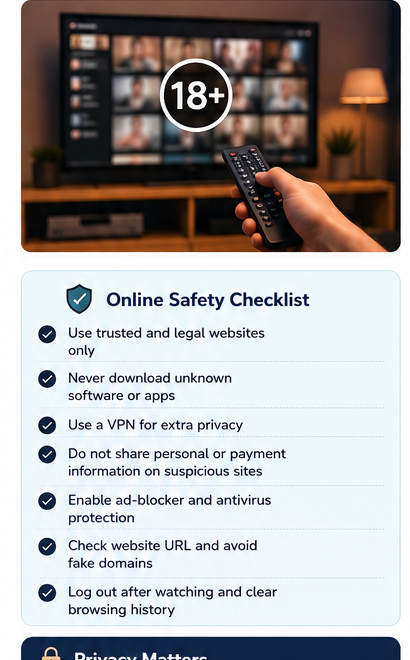
Online-safety illustration: verify the site before sharing credentials, payment information, or installing software.
A Practical Safety Checklist Before You Create an Account
- Read the domain carefully and watch for misspellings, extra words, suspicious subdomains, or a domain that does not match the brand shown on the page.
- Confirm what is actually free. A preview, trial, promotional sample, subscription, rental and full free access are not the same thing.
- Read recurring-billing and cancellation terms before entering payment information.
- Keep your browser, operating system and security software updated.
- Use a unique password; do not reuse the password protecting your primary email, banking or work accounts.
- Use multi-factor authentication when the service supports it.
- Do not automatically approve browser notifications, camera, microphone, location, or extension permissions.
- If a message or page asks you to “verify” payment or account details unexpectedly, navigate independently to the service instead of trusting the link.
- Avoid uploading identity documents to an unfamiliar service unless you have independently verified why the request is necessary and how the data will be handled.
The FTC’s Online Privacy and Security resources provide broader guidance on protecting personal information, accounts and devices from scams and privacy risks.
How Google SafeSearch Treats Explicit Content
Google treats explicit content differently from ordinary entertainment pages. Its explicit-content guidance explains that SafeSearch is designed to filter results leading to explicit sexual content, nudity, sex-oriented services, violence or gore, and links to pages containing explicit content. Google says its systems use signals that can include text, images, videos and links when classifying pages. Google’s guidelines for sites with explicit content also explain how publishers can help Google understand explicit pages.
For publishers, that means the article, images, embeds, pop-ups and outbound links all matter. If the goal is an informational guide, there is little SEO benefit in adding graphic imagery that is not needed to answer the reader’s question. A non-explicit featured image focused on streaming, privacy, age-appropriate context and online safety is usually a cleaner editorial choice.
What Adult-Site Publishers Should Know About Explicit-Content SEO
If a site actually hosts substantial sexually explicit material, Google recommends helping its systems identify the content accurately. Its current guidance includes grouping explicit pages separately when appropriate, ensuring Googlebot can crawl content needed for classification, and using supported explicit-content metadata for relevant pages. One recognized example is the adult rating meta tag described in Google’s documentation. Read the current explicit-content SEO guidelines before implementing technical changes, because site architecture and access controls can affect crawling and classification.
How to Evaluate Search Results Without Assuming the First Result Is Safe
Search position is not a safety certification. The FTC has warned that scammers can use paid search results and misleading branding to steer people toward impersonation or scam pages. When money, credentials or personal information are involved, verify the domain and contact information independently rather than relying only on the result snippet. FTC guidance on scammy search results recommends checking that you are dealing with the organization you intended to reach.
Privacy: What Private Browsing Does – and Does Not – Do
Private or incognito browsing mainly changes what the browser keeps locally after the session. It should not be described as guaranteed anonymity. Websites, services you sign into, network operators and other parties may still receive information about activity depending on the setup. The more useful privacy habits are limiting unnecessary permissions, using unique credentials, keeping software updated, reviewing what data a service collects, and avoiding suspicious forms or downloads.
How to Make This Topic Useful Instead of Search-Engine-First
For publishers targeting the keyword “sex movies,” the article should add original value rather than simply rewording competitors. Google’s people-first content guidance asks whether a page offers original information or analysis, provides a substantial and complete description, clearly identifies who created the content, and leaves readers feeling they learned enough to achieve their goal. Google also says E-E-A-T itself is not a single ranking factor; trust is the most important component of the concept. Google’s people-first content guidance is the best primary reference for these principles.
Good additions for a genuinely useful page include:
- A concise legal-access versus unauthorized-access comparison.
- A real checklist for evaluating unfamiliar streaming pages.
- Clear explanations of billing, redirects, permissions and privacy risks.
- Current citations to primary sources rather than recycled SEO claims.
- An author byline, About page, editorial policy, Contact page and visible last-updated date.
- Original non-explicit images with descriptive alt text and appropriate compression.
- FAQs that answer real searcher concerns without inventing facts or fake “free access” promises.
Frequently Asked Questions
Are sex movies legal to watch online?
Legality depends on the content, licensing, how it was obtained, and the jurisdiction. Access provided by a rights holder or authorized distributor is different from an unauthorized copy. This article does not provide country-specific legal advice.
Does “free” mean a streaming page is legal?
No. “Free” only describes price. A legitimate publisher may offer previews or promotions for free, while an unauthorized site may also claim free access. Verify the operator and licensing context rather than relying on the word itself.
Is every unknown adult website dangerous?
No, but unfamiliar sites deserve more verification. Several warning signs together – unclear ownership, forced downloads, endless redirects, hidden billing, or requests for unnecessary sensitive information – are a reason to leave.
Can a streaming page install malware?
Risk commonly increases when a visitor is persuaded to download software, extensions or files. Keep the browser and security software updated, and do not install unknown components merely because a page says they are required.
Does incognito mode make adult browsing anonymous?
No. It mainly limits local browser history and related storage for that session. It should not be treated as complete anonymity from websites, accounts, networks or other services.
Does Google SafeSearch block adult pages?
SafeSearch is designed to filter explicit results according to the user’s setting. Classification is automated and uses multiple signals, so publishers should follow Google’s explicit-content guidance rather than trying to disguise what a page contains.
Should I enter a card number for a “free verification”?
Treat unexpected payment verification cautiously. If you intended to use a legitimate service, navigate independently to its official site and check the account or billing page there instead of trusting an unexpected pop-up or redirect