
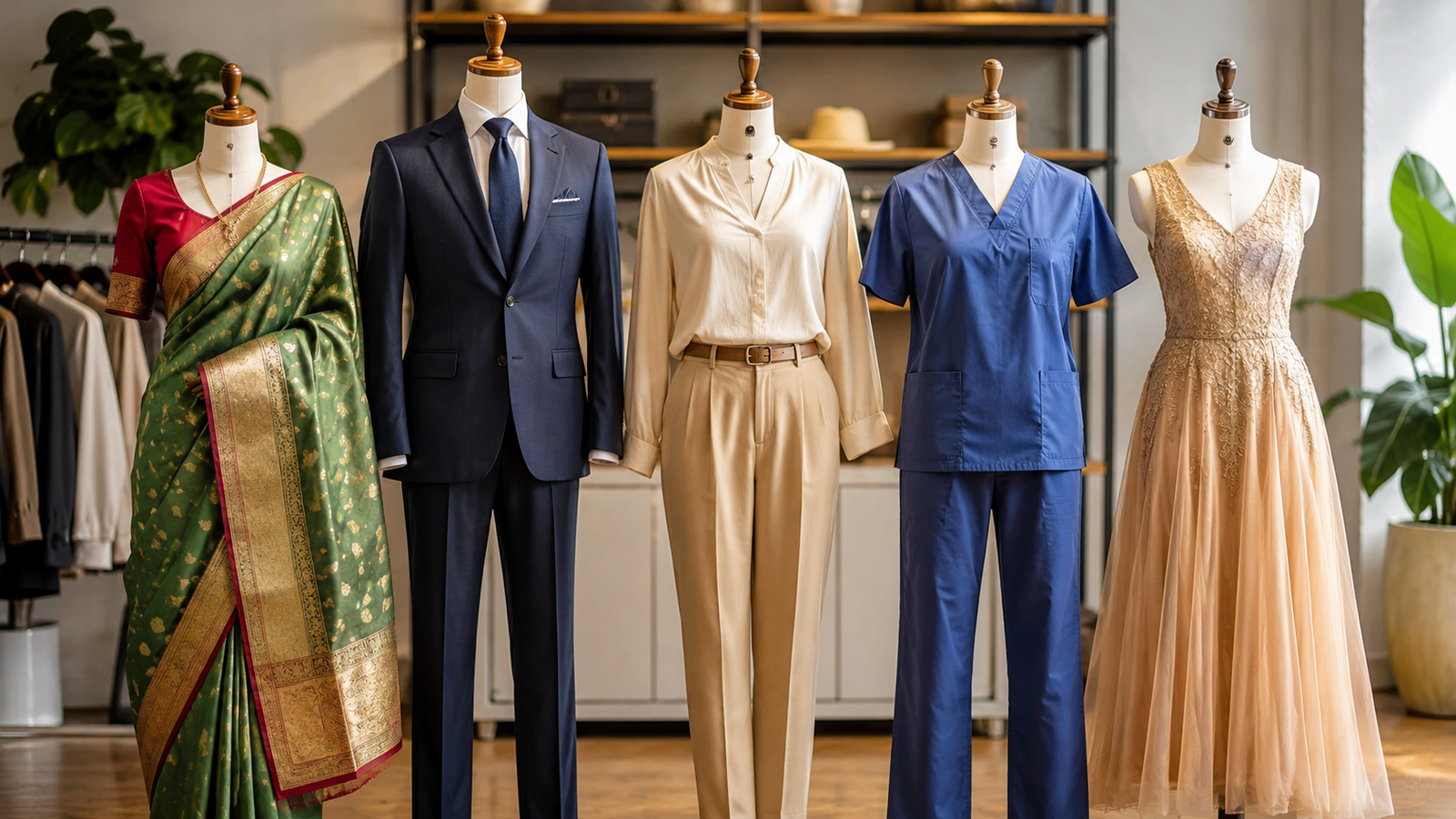
Garb definition, in simple terms: garb means clothing of a particular type, style, role, culture, period, or purpose. The word often appears when the clothes themselves help identify who a person is, what role they have, or what setting they belong to. You might read about traditional garb at a cultural celebration, military garb in a historical account, clerical garb in a religious context, or period garb at a reenactment.
This is slightly more specific than simply saying “clothes.” Garb usually draws attention to the character or style of the clothing. Merriam-Webster describes the noun as a style of apparel and also records a figurative sense connected with outward form or appearance. Cambridge Dictionary presents the word as literary or formal and explains it as clothes of a particular type.
Quick answer: If a sentence says someone is “in ceremonial garb,” it means that person is wearing the distinctive clothing associated with a ceremony. If it says someone is “garbed in black,” the verb form means dressed or clothed in black.
What Does Garb Mean?
The easiest way to understand garb is to think of clothing that communicates context. Ordinary jeans and a T-shirt are simply clothes in most situations. A carefully recognizable uniform, regional outfit, historical costume, or ceremonial robe may be called garb because the style tells us something about the wearer or occasion.
In modern English, garb often appears in descriptive writing, journalism, historical writing, museum material, fantasy, literature, and discussions of culture or ceremony. It is less likely to appear in casual everyday speech than words such as clothes or outfit. That does not make it obsolete; it simply gives the word a more descriptive and sometimes formal tone.
Garb Definition in Simple English
A practical plain-English definition is: “a recognizable type or style of clothing, especially one connected with a group, profession, culture, period, activity, or occasion.” This wording captures the usual modern sense without treating garb as a perfect synonym for every piece of clothing.
| Word | garb |
| Part of speech | noun; also used as a verb |
| Simple meaning | distinctive clothing or a particular style of dress |
| Typical tone | descriptive, literary, historical, or somewhat formal |
How to Pronounce Garb
The word is one syllable. A simple pronunciation guide is UK “gahb” and US “gahrb.” The American pronunciation clearly includes the r sound. For exact phonetic symbols and audio, use the Cambridge pronunciation link below.
For audio pronunciation, see the Cambridge pronunciation guide.
Garb as a Noun
As a noun, garb refers to clothing or a style of clothing. It is normally an uncountable noun in this sense, so English speakers tend to say “traditional garb” or “military garb” rather than “a garb.” The surrounding adjective usually tells you what kind of dress is being described.
- Traditional garb: clothing associated with a culture, region, community, or heritage.
- Military garb: clothing associated with soldiers, military service, or a historical military setting.
- Clerical garb: distinctive clothing associated with clergy.
- Ceremonial garb: clothing worn for a formal rite, celebration, or ceremony.
- Period garb: clothing styled to represent a particular historical era.
Garb as a Verb
Garb can also be a verb meaning to dress or clothe someone in a particular way. This use is less common in everyday conversation, but it appears in descriptive prose. The forms include garbed, garbing, and garbs.
Example: “The performers were garbed in dark robes for the final scene.” Here, garbed simply means dressed.
Common Types of Garb
The word becomes especially useful when clothing carries a visible social, cultural, historical, or professional meaning. These are some of the most common contexts in which readers encounter it.
Traditional Garb
Traditional garb is clothing associated with the customs or identity of a particular region, culture, community, or historical tradition. Depending on context, it may be worn every day, reserved for festivals and weddings, or used mainly for cultural presentation. Good writing should avoid treating all traditional clothing as costume; for many people, these garments are living expressions of heritage rather than theatrical dress.
Military Garb
Military garb may refer to uniforms, field clothing, ceremonial dress, or historical military attire. The phrase often appears when the visual identity of the uniform matters more than the name of each garment. In precise military writing, however, “uniform” is usually the better word when an official uniform is specifically meant.
Clerical and Religious Garb
Clerical garb refers to distinctive clothing associated with clergy. Religious garb is broader and can include clothing with significance in many faith traditions. Because these forms of dress can carry deep religious meaning, writers should identify the garment or tradition accurately when the information is known rather than using garb as a vague label.
Period Garb
Period garb describes clothing intended to represent a historical era. It is common in reenactment, theatre, heritage interpretation, living-history events, and historical fiction. A period outfit can be carefully researched or loosely inspired by an era, so “period garb” does not automatically mean every detail is historically exact.

Original editorial illustration: period-style garb can visually signal a historical setting.
Examples of Garb in Sentences
- The dancers arrived in brightly colored traditional garb for the cultural festival.
- The museum guide wore period garb while explaining how the household operated in the eighteenth century.
- The actor changed from modern clothes into ceremonial garb before the scene began.
- The photograph shows the soldiers in winter military garb.
- The priest’s clerical garb made his role immediately recognizable.
- Visitors were encouraged to wear medieval-inspired garb to the historical fair.
- The designer borrowed details from regional garb without copying any single traditional outfit.
- The performers were garbed in silver and black for the final number.
- The story presents a modern conflict in the garb of an old legend.
- For the parade, the group chose formal garb associated with its local tradition.
- The exhibition compares everyday clothing with ceremonial garb from the same period.
- The fantasy characters are garbed in layered robes suited to the fictional climate.
Garb Synonyms: Which Word Fits Best?
Garb overlaps with several clothing words, but they are not identical in tone. Choosing the right synonym can make a sentence sound more natural and precise.
| Word | Best use | Nuance |
| garb | Distinctive style of clothing | Descriptive; often formal, historical, cultural, or role-based |
| attire | Clothing as a whole | Formal or polished; common in “business attire” or “formal attire” |
| clothing | General term | Neutral and broad |
| outfit | A coordinated set of clothes | Everyday and conversational |
| costume | Dress for performance, disguise, character, or some traditional contexts | Can suggest theatrical or special-purpose dress, so use carefully for living cultural traditions |
| apparel | Clothing, especially as a category | Common in retail, business, and formal writing |
| garment | One individual article of clothing | Refers to a specific piece rather than an overall style |
Merriam-Webster’s thesaurus lists words such as costume, attire, clothes, dress, outfit, and apparel among related choices. See its garb thesaurus entry for a broader synonym set.
Garb vs. Garment
Garb and garment sound similar but refer to different levels of clothing. A garment is normally one article of clothing: a coat, shirt, dress, robe, or pair of trousers. Garb usually describes the overall style or type of dress. A ceremonial robe may be a garment; the full recognizable style worn for the ceremony may be described as ceremonial garb.
This distinction also matches the historical dictionary sense of garment as an individual article of clothing. For word history, compare Etymonline’s entry for garment.
Garb vs. Attire
Attire is another word for clothing, but it is often used to describe what is appropriate for a setting: business attire, evening attire, formal attire, or casual attire. Garb is more likely to emphasize a distinctive identity or style: monastic garb, traditional garb, period garb, or military garb. In some sentences either word works, but the emphasis changes.
Garb vs. Costume
Costume can mean clothing worn to portray a character, participate in a performance, attend a themed event, or represent a historical style. Garb does not necessarily suggest acting or disguise. That difference matters when discussing cultural or religious clothing: calling living traditional dress a “costume” can sound as though the clothing is only theatrical, while “traditional garb,” “traditional dress,” or the garment’s specific name may be more respectful and accurate.
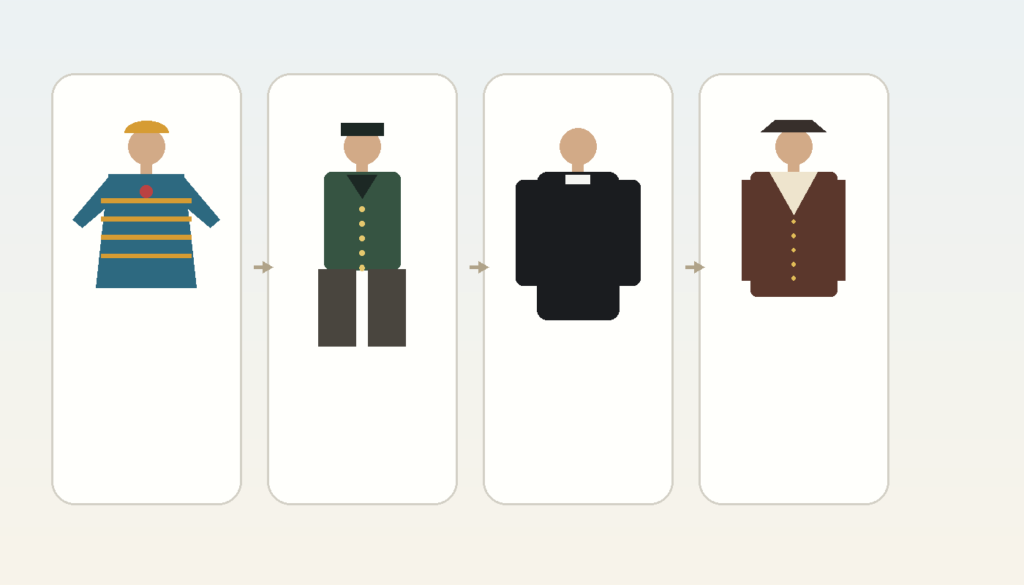
Original editorial illustration: “garb” is often used when clothing signals culture, role, faith, or historical period.
Origin and Etymology of Garb
The history of garb is older and more complicated than its modern definition suggests. Etymonline traces the clothing sense to the 1620s, after earlier English senses related to outward manner, elegance, or style. It connects the history with French and Italian forms associated with grace, outline, or elegance. Modern etymological notes differ on some deeper details, so it is better to present the origin as a documented development rather than claim a single uncontested ancient source.
For the detailed historical trail, see Etymonline: garb and Merriam-Webster’s word history.
Is Garb Formal or Old-Fashioned?
Garb is not obsolete, but it is more marked than everyday words such as clothes or outfit. Cambridge labels the noun literary in its main British-English entry and formal in its American-dictionary treatment. That fits how the word is commonly used: it sounds natural in descriptive, historical, journalistic, cultural, ceremonial, or literary contexts, but can sound unusually formal in a sentence about ordinary daily clothing.
For example, “I bought a new outfit for dinner” sounds natural in conversation. “I bought new garb for dinner” would sound playful, stylized, or deliberately unusual unless the dinner involved a specific dress tradition.
Can Garb Be Used Figuratively?
Yes. Garb can move beyond literal clothing and describe an outward form or presentation. A writer might say an old idea appears “in modern garb,” meaning that its underlying substance is old even though its presentation looks new. This figurative sense works because the word already carries the idea of an outward appearance that can signal — or sometimes disguise — what is underneath.
How to Use Garb Naturally
The strongest uses of garb answer an unspoken question: what makes these clothes distinctive? If the sentence can name the identity, role, period, tradition, or occasion, garb is often a good choice.
- Use a clear modifier: traditional garb, ceremonial garb, military garb, historical garb, protective garb, or clerical garb.
- Prefer the specific garment name when precision matters: sari, kimono, cassock, kilt, thobe, hanbok, robe, tunic, uniform, and so on, when you know the correct term.
- Avoid using garb merely as a fancy replacement for clothes in every sentence.
- When writing about cultures or faiths, verify terminology and avoid implying that meaningful living dress is only a costume.
- For search-friendly writing, answer the definition immediately, then expand with examples and comparisons rather than repeating the focus keyword unnaturally.
Frequently Asked Questions About Garb
What is the simplest garb definition?
Garb means a particular type or style of clothing, especially clothing that is distinctive because of a culture, role, profession, period, or occasion.
Is garb the same as clothes?
Not exactly. Clothes is the broad everyday term. Garb usually emphasizes a recognizable style, identity, or context.
Is garb a noun or a verb?
It is both. As a noun, it refers to a style or type of clothing. As a verb, to garb means to dress or clothe.
What does traditional garb mean?
Traditional garb means clothing associated with a cultural, regional, community, or historical tradition.
What does military garb mean?
It refers to military-style clothing or dress associated with soldiers or military contexts. If an official uniform is meant, “uniform” may be more precise.
What does clerical garb mean?
Clerical garb is distinctive clothing worn by clergy. The exact garments vary by religious tradition and role.
Is garb an old-fashioned word?
It can sound literary or formal, but it is still used in modern English, especially when clothing is distinctive or descriptive context matters.
Can I call any outfit garb?
Grammatically, the word can refer broadly to dress, but in natural modern usage it usually sounds best when the clothing has a recognizable type, role, style, or context.
What is the difference between garb and garment?
A garment is usually one individual article of clothing. Garb usually refers to an overall style or type of dress.
What are good synonyms for garb?
Depending on context: attire, dress, clothing, clothes, outfit, costume, apparel, or vestments. None is an exact replacement in every sentence.