
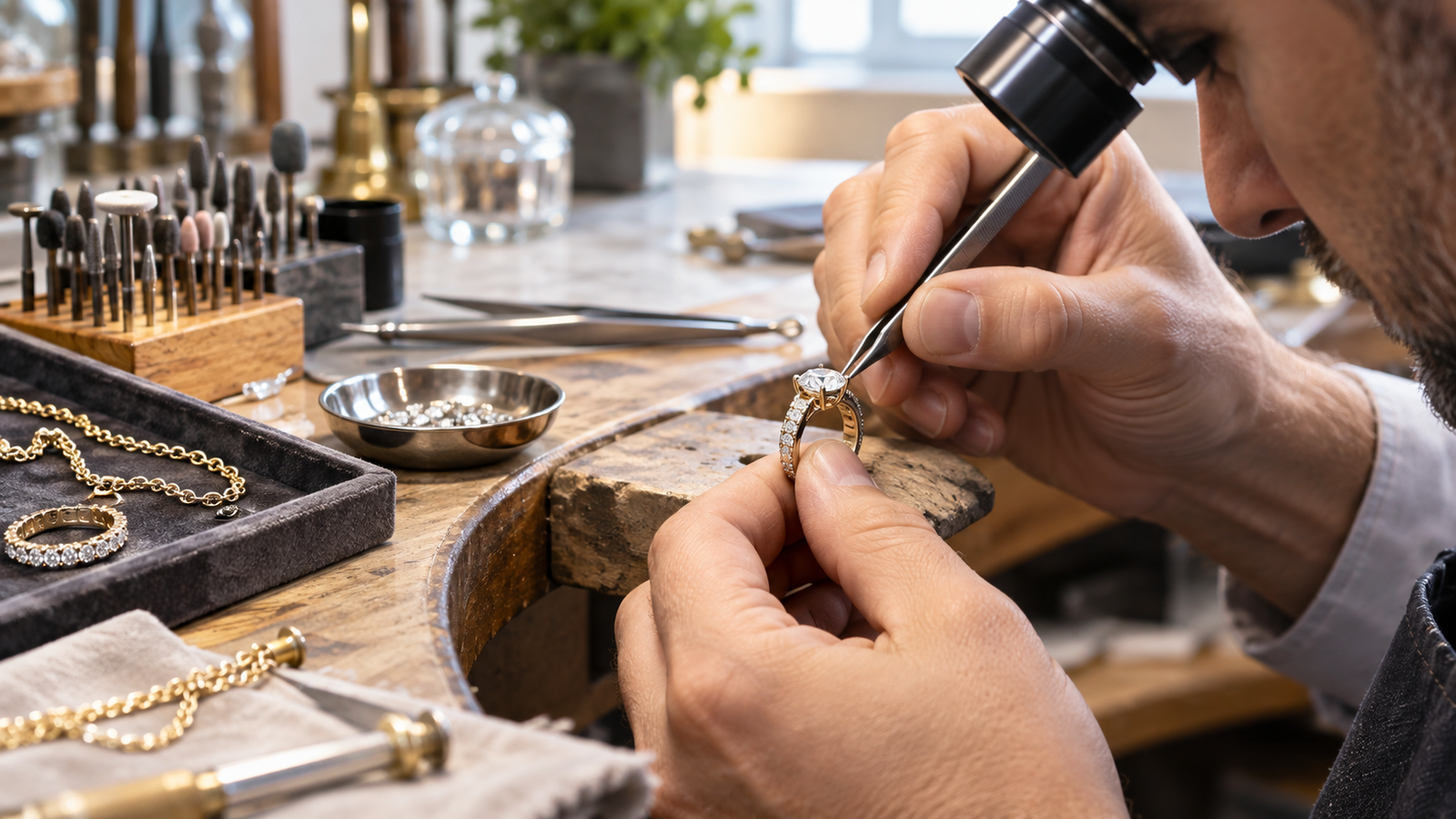
Jewelry often means more than its price or appearance.
A ring may remind someone of an engagement or wedding. A necklace may come from a loved one. An old bracelet may have stayed in a family for years.
People also wear these pieces often. Daily use can slowly cause damage.
A chain may break. A ring may become too tight or loose. A clasp may stop closing properly. A gemstone may also start moving inside its setting.
When these problems appear, a jewelry repair service can help.
What Is Jewelry Repair?
Jewelry repair means fixing damaged, worn, loose, or broken jewelry.
A good repair should do two things.
First, it should make the jewelry safe to wear again.
Second, it should keep the original look and shape as much as possible.
Professionals who do this work are often called bench jewelers.
They repair many types of jewelry, including:
- Rings
- Necklaces
- Earrings
- Bracelets
- Pendants
- Gemstone settings
Bench jewelers deal with many common problems. These include broken chains, worn prongs, loose settings, and damaged clasps.
The type of repair depends on the condition of each piece.
What Are the Most Common Types of Jewelry Repair?
Different jewelry pieces develop different problems.
Some problems affect the metal. Others affect the gemstone setting or small parts.
Common jewelry repairs include:
- Ring resizing
- Broken chain repair
- Clasp repair or replacement
- Loose stone tightening
- Prong repair or re-tipping
- Ring shank repair
- Stone replacement
- Earring post repair
- Earring back repair
- Polishing
- Refinishing
- Restoration of old jewelry
Some pieces need only one repair.
Older jewelry may need work in several areas.
Ring Resizing
Ring resizing is one of the most common jewelry repairs.
A ring may need resizing if it becomes too tight or too loose.
Finger size can change over time. Because of this, a ring that once fitted well may no longer feel comfortable.
Resizing a ring is not as simple as making it bigger or smaller.
The jeweler needs to check:
- The type of metal
- Ring width
- Overall design
- Gemstone setting
- Shape of the band
GIA quality guidance says jewelers should keep the ring’s original shape during changes.
For example, flat parts should stay flat. Curved parts should also keep their original shape.
This matters even more when the ring has detailed designs or gemstones around the band.
Changing the ring size can also affect the stone setting.
Loose Stones and Gemstone Settings
You should not ignore a loose gemstone.
Different settings can hold gemstones in place.
Common settings include:
- Prongs
- Bezels
- Channels
- Other metal supports
GIA describes prongs as small metal parts that hold the edges of a gemstone.
Over time, these parts can become thin or worn.
A gemstone may also become loose after a hit or impact.
In some cases, the metal around the stone slowly wears down.
Jewelers Mutual lists loose stones as a common reason for ring repair.
A stone that moves or makes a small rattling sound may no longer sit securely in its setting.
A jeweler can inspect the piece and decide whether the stone only needs tightening or whether the setting needs repair.
What Is Prong Repair?
Prongs are small metal parts that hold many gemstones in place.
Because prongs stay exposed, daily wear can slowly damage them.
They may become:
- Thin
- Bent
- Weak
- Worn
One warning sign is a ring that keeps catching on clothes or hair.
Damaged prongs can put the gemstone at risk.
A jeweler may strengthen, rebuild, or repair them depending on their condition.
GIA also mentions re-tipping.
Re-tipping adds metal to worn prong tips so they can hold the stone more securely.
For this reason, checking the setting is just as important as checking the gemstone.
Broken Chain Repair
Necklaces and bracelets contain many small links.
These links can become weak with regular use.
A chain may break because:
- A link becomes thin
- The chain gets pulled
- A section gets damaged
- The clasp area becomes weak
Bench jewelers regularly repair broken chains.
The right repair depends on the chain’s:
- Metal
- Thickness
- Design
- Construction
- Location of damage
A jeweler should also check the links near the damaged area.
Sometimes the visible break is not the only weak point.
Clasp Repair and Replacement
People use necklace and bracelet clasps often.
Because of this, clasps can wear out over time.
A weak clasp may stop closing properly.
If that happens, the jewelry can fall off without the wearer noticing.
Sometimes a jeweler can repair the old clasp.
In other cases, replacing it makes more sense.
A damaged clasp may look like a small issue, but it plays an important role.
It keeps the whole piece secure.
Damaged or Worn Ring Bands
The part of a ring that goes around the finger is called the shank.
Over time, the shank may become:
- Thin
- Bent
- Cracked
- Misshapen
Jewelers Mutual explains that a jeweler may reshape some damaged shanks.
However, serious cracks or very thin metal may need a bigger repair.
For heavily worn rings, the jeweler may need to replace part of the weak section.
This explains why an old ring can need repair even when the gemstone still looks fine.
Jewelry Repair and Jewelry Restoration Are Not Exactly the Same
Jewelry repair usually fixes one clear problem.
For example:
- A jeweler can repair a broken chain.
- A jeweler can tighten a loose stone.
- A jeweler can replace a damaged clasp.
- A jeweler can fix worn prongs.
Jewelry restoration usually involves more work.
People often choose restoration for:
- Antique jewelry
- Vintage jewelry
- Heirloom pieces
- Heavily worn jewelry
The goal is often to improve several damaged areas while keeping the original style.
Jewelers Mutual notes that bench jewelers may restore old and heirloom jewelry that has suffered from long-term wear.
For older or sentimental jewelry, keeping the original look can be very important.
Does the Type of Metal Affect Jewelry Repair?
Yes.
Gold, silver, platinum, and other metals behave differently.
Each metal may need a different repair method.
GIA explains that even platinum alloys can have different working properties.
When a jeweler repairs platinum, the repair material should match the original alloy as closely as possible.
Using the wrong material may cause problems.
The jeweler should also keep the original size and shape of the piece during the repair.
This means one repair method may work for one piece but not for another.
Does the Type of Gemstone Matter During Repair?
Yes.
The gemstone can strongly affect the repair method.
Different stones react differently to:
- Heat
- Chemicals
- Pressure
- Steam
- Cleaning methods
GIA explains that some colored gemstones have treatments that can react badly to heat, solvents, steam, or ultrasonic cleaning.
Some stones need extra care.
These may include:
- Pearls
- Opals
- Turquoise
- Other delicate stones
A jeweler should identify the stone before cleaning or repairing the piece.
Even diamonds can suffer damage.
Diamonds are very hard, but a strong impact in the wrong direction can still damage them.
Extreme temperature changes may also cause problems.
Is Polishing Considered Jewelry Repair?
Polishing is usually part of jewelry care and refinishing.
It does not normally fix major structural damage.
However, many repair services also offer polishing.
For example, Tiffany & Co. offers services such as:
- Polishing
- Prong checks
- Ring resizing
- Cleaning
- Repairs
Polishing can improve scratched or dull metal.
However, you should not polish jewelry too often without a reason.
Tiffany notes that polishing silver removes a small amount of metal each time.
Because of this, repeated polishing may slowly wear down the piece.
The best care method depends on the jewelry’s material and condition.
Can Jewelry Be Cleaned at Home?
Some jewelry can be cleaned at home.
However, one cleaning method does not work for every piece.
GIA says many colored gemstones can be cleaned with:
- Warm water
- Mild soap
- A soft brush
- A soft cloth
Still, some stones need more careful treatment.
This includes treated, delicate, organic, or cracked gemstones.
Ultrasonic cleaners are a good example.
These machines can remove dirt from small areas.
However, GIA warns that they are not safe for every gemstone.
The vibration may also loosen stones that already have weak settings.
If you do not know the gemstone type or treatment, a professional inspection is safer.
How Do You Know When Jewelry Needs Repair?
Several warning signs can show that jewelry needs attention.
Look for:
- A gemstone that moves
- A ring that catches on clothing
- A bent prong
- A missing prong
- A cracked ring band
- A thin ring band
- A loose clasp
- A clasp that does not close
- A chain with stretched links
- Damaged chain links
- A loose earring post
- A ring that no longer fits
- Damage around a gemstone
- A piece that has lost its shape
You may not always see every problem.
Jewelers of America recommends regular inspection of fine jewelry.
A jeweler can check for loose prongs, worn settings, and general damage.
An early inspection may find small problems before they become serious.
How Much Does Jewelry Repair Cost?
Jewelry repair does not have one fixed price.
The cost depends on several things.
These include:
- Type of jewelry
- Type of metal
- Number of gemstones
- Type of gemstones
- Level of damage
- Design complexity
- Replacement parts
- Amount of labor
- Type of repair
For example, replacing a simple clasp usually needs less work than rebuilding a gemstone setting.
Restoring an antique ring can also take much more work.
Because of this, a jeweler usually needs to see the piece before giving an accurate price.
How Long Does Jewelry Repair Take?
Repair time also depends on the type of work.
A small repair may take less time.
A complex restoration may take longer.
The jeweler may need time to:
- Inspect the piece
- Identify the metal
- Check the gemstone
- Order parts
- Complete the repair
- Check the piece again
Because every repair is different, there is no single repair time for all jewelry.
Why Professional Jewelry Repair Matters
A broken clasp or bent ring may look easy to fix.
However, jewelry often has small and detailed parts.
A repair can affect areas that are hard to see.
Bench jewelers train to work with:
- Metals
- Gemstones
- Settings
- Finishing methods
Jewelers of America recommends checking the skill and experience of the person handling the jewelry.
Its Bench Professional Certification program checks the knowledge and skills used in professional jewelry work.
Professional help matters even more for:
- Valuable jewelry
- Sentimental jewelry
- Antique pieces
- Gemstone jewelry
- Complex designs
What Should You Consider Before Choosing a Jewelry Repair Service?
Before leaving jewelry for repair, ask a few simple questions.
You may want to ask:
- What part is damaged?
- What repair do you recommend?
- Do you need to replace any original parts?
- Can the repair affect the gemstone?
- Can the repair affect the design?
- Will you repair the piece on-site?
- What will the estimated cost be?
- How will you check the finished work?
For old or valuable jewelry, photos can also help.
You can take pictures before leaving the piece for repair.
A written note about its condition may also be useful.
Most importantly, the jeweler should explain the repair in simple terms.
Can Old Jewelry Be Repaired?
Yes, many old jewelry pieces can be repaired.
Some can also be restored.
The jeweler needs to check:
- Metal condition
- Gemstones
- Settings
- Old repairs
- Weak areas
An old ring may have more than one problem.
For example, it may have a thin shank and worn prongs.
Fixing only one issue may leave another weak area.
A full inspection can help find all important problems.
Is Jewelry Repair Worth It?
The answer depends on the piece.
Some jewelry has high financial value.
Other pieces matter because of memories or family history.
Before deciding, consider:
- Repair cost
- Condition
- Replacement materials
- Age of the piece
- Sentimental value
- Financial value
- Original design
A good first step is to ask a jeweler to inspect the item.
Once you understand the damage and repair cost, you can decide whether repair, restoration, or replacement makes the most sense.
FAQs
What is jewelry repair?
Jewelry repair means fixing damaged, worn, loose, or poorly fitting jewelry.
It may include work on rings, chains, clasps, gemstones, prongs, earrings, and other parts.
Can a broken jewelry chain be repaired?
Yes, many broken chains can be repaired.
The right repair depends on the chain’s metal, design, thickness, and level of damage.
A jeweler should also check nearby links for weakness.
Can a loose gemstone be fixed?
Yes, in many cases.
A jeweler may tighten the setting.
If the prongs or other parts are badly worn, the piece may need more repair work.
What is prong repair?
Prong repair fixes the small metal parts that hold a gemstone.
A jeweler may rebuild, strengthen, or re-tip worn prongs.
Can old jewelry be restored?
Yes, many antique, vintage, and heirloom pieces can be restored.
The final result depends on the condition of the metal, stones, and settings.
How much does jewelry repair cost?
There is no fixed price.
The cost depends on the metal, gemstones, damage, parts, design, and amount of work.
How do I know if my ring needs repair?
Look for loose stones, worn prongs, cracks, bends, snagging, or a change in shape.
A regular inspection can also find damage that is hard to see.
Can all jewelry be cleaned the same way?
No.
Some gemstones can react badly to heat, chemicals, steam, or ultrasonic cleaners.
Always choose a cleaning method that suits the specific metal and gemstone.
What is the difference between jewelry repair and restoration?
Repair usually fixes one clear problem.
Restoration often fixes several worn or damaged areas, especially on older jewelry.
Should damaged jewelry be repaired professionally?
For loose stones, major damage, valuable pieces, antique jewelry, or special metals, professional help is usually the safer choice.
A trained jeweler can check the materials and structure before starting the repair.