
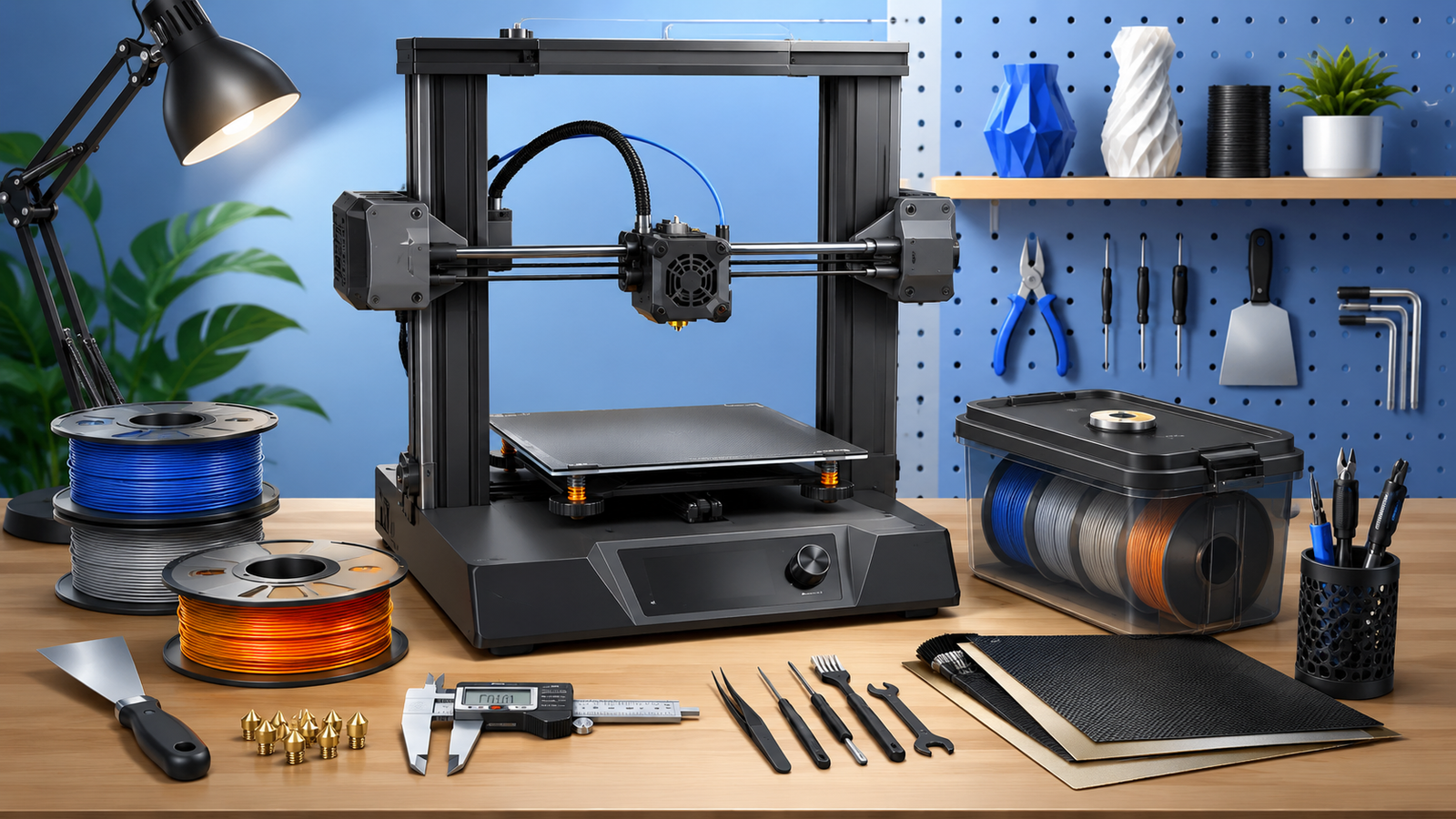
| Quick answerThe most useful 3D printer accessories are the ones that solve common problems: accurate measurement, filament moisture, worn nozzles, dirty build surfaces, and routine maintenance. For most FDM beginners, start with a digital caliper, dry filament storage, a compatible spare nozzle or hotend, and the basic tools recommended by your printer maker. Add a powered dryer, enclosure, or specialty build plate only when your materials or workflow actually need them. |
A 3D printer can work straight out of the box, but a few well-chosen accessories can make the experience much easier. The key is not to buy every upgrade you see. Instead, match each accessory to a real problem in your setup.
This guide focuses mainly on FDM/FFF printers because they are common for home and hobby use. Resin printers involve liquid resins and different safety requirements. Younger users should only handle resin systems with trained adult supervision and the manufacturer’s safety instructions.
Search Intent: What People Want From “3D Printer Accessories”
The keyword has mixed intent. Some readers want a simple beginner checklist. Others want upgrades that improve reliability, storage, print quality, or maintenance. A strong article should answer both needs without turning into a random shopping list.
| Search need | What the reader wants | Best content format | Keyword examples |
| Beginner setup | What do I actually need? | Priority checklist | essential 3d printer accessories; 3d printer accessories for beginners |
| Problem solving | Fix moisture, measurement, adhesion, or wear | Use-case sections | filament storage; digital caliper; spare nozzles |
| Upgrade research | Which add-ons are worth buying later? | Pros, limits, and who needs it | filament dryer; enclosure; build plate |
| Maintenance | What should I keep on hand? | Routine maintenance list | 3d printer maintenance accessories |
Google’s current guidance says useful content should provide original value, clear sourcing, and a satisfying answer for readers. It also advises creators to think about who made the content, how it was produced, and why it exists.
SEO reference: Google Search Central — Creating helpful, reliable, people-first content
Fresh AI-search reference: Google Search Central — Generative AI features optimization guide
How This Guide Was Researched
This is a research-based guide, not a claim that every accessory below was personally tested. Recommendations were selected by comparing official manufacturer documentation, current 3D-printing guides, and community discussions. Technical claims were kept tied to primary sources whenever possible.
- Official documentation was used for filament moisture, nozzle compatibility, and printer behavior.
- Current community discussions were used to see which accessories beginners repeatedly ask about.
- Accessory-guide sources were used for topic coverage, not copied product rankings.
- The list is organized by practical need instead of affiliate commission or brand popularity.
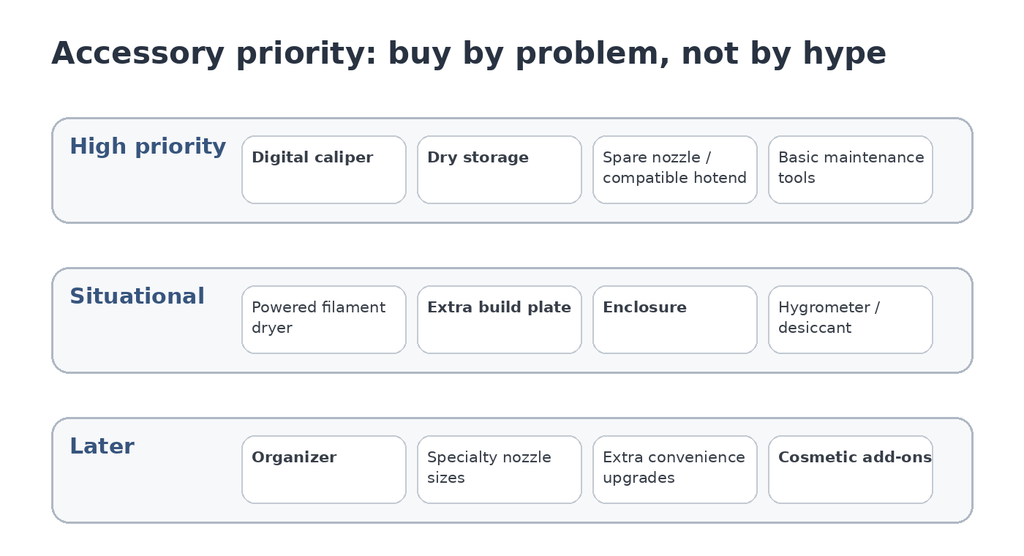
A better buying rule: start with high-value basics, then add situational accessories only when a real need appears.
3D Printer Accessories at a Glance
| Accessory | Main job | Beginner priority | Best for |
| Digital caliper | Measure parts and check dimensions | High | Almost every FDM user |
| Dry filament storage | Slow moisture absorption | High | Anyone storing open spools |
| Powered filament dryer | Remove moisture from suitable filament | Medium / situational | Humid rooms and moisture-sensitive materials |
| Spare nozzle or hotend | Replace worn or clogged components | High | Regular printers |
| Extra build plate | Reduce downtime and match materials | Medium | Frequent printing |
| Hygrometer + desiccant | Track and manage storage humidity | Medium | Dry-box users |
| Basic maintenance tools | Tighten, inspect, and service parts | High | All owners |
| Enclosure | Control the print environment | Situational | Materials that benefit from stable chamber conditions |
1. Digital Caliper: The Most Useful Measurement Tool
A digital caliper is one of the easiest accessories to justify. It lets you measure a printed part instead of guessing whether it is too large, too small, or simply designed with the wrong clearance.
This becomes especially useful when you start making functional parts. You can compare a real-world object with your CAD model, check a test cube, or confirm that two printed parts have the clearance you expected.
- Measure outside dimensions, inside openings, and depth.
- Check printed parts against the dimensions in your model.
- Use actual measurements before changing slicer or printer calibration settings.
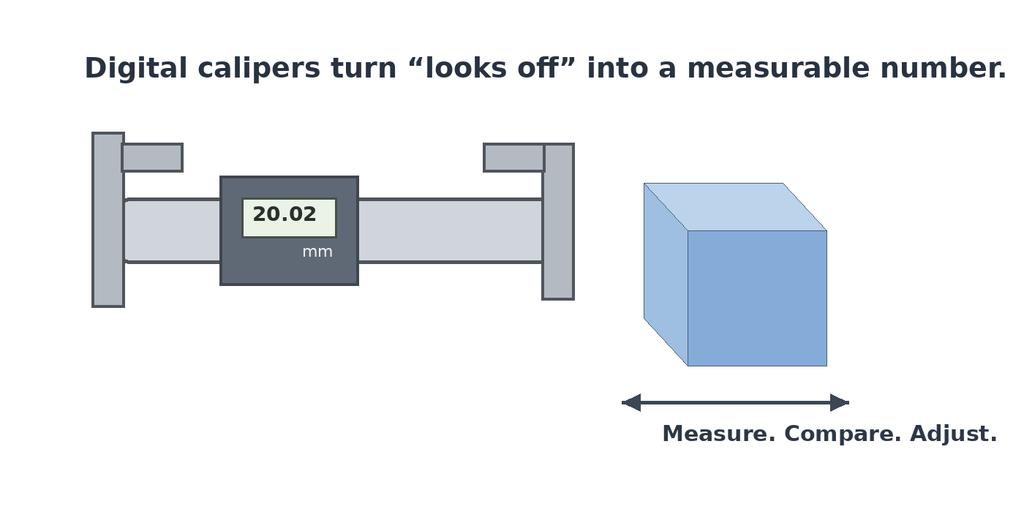
A caliper gives you a number you can compare with your design instead of relying on visual judgment.
Community signal: recent r/3Dprinting accessory discussions repeatedly mention digital calipers, dry storage, and simple post-processing tools as useful early purchases. See a 2026 beginner accessory discussion on Reddit.
2. Dry Filament Storage: A Basic Accessory That Prevents Problems
Many FFF filaments absorb water from the air. The effect varies by material, but moisture can change how filament behaves during printing. That is why sealed storage is more than a neat way to organize spools.
For opened filament, a sealed container or purpose-built dry box with suitable desiccant can slow moisture uptake. This is especially useful if you live in a humid climate or keep filament for long periods.
Technical reference: Prusa Knowledge Base — Drying filament
3. Filament Dryer: Useful, but Not Automatically Essential
A dry box and a filament dryer do different jobs. A dry box mainly helps keep dry filament from absorbing moisture quickly. A dryer is meant to remove moisture that is already in suitable filament.
That difference matters. If you mostly print PLA in a dry room and finish spools quickly, a powered dryer may not be your first purchase. If you use more moisture-sensitive materials or print in a humid room, it can move much higher on the list.
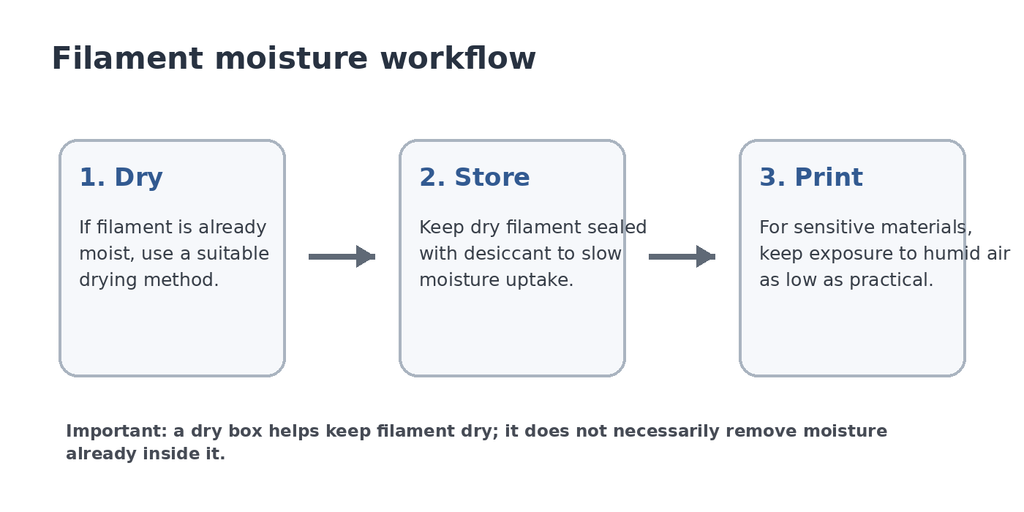
Dry first when needed, then use sealed storage to slow moisture from returning.
Useful distinction from Prusa: the USS Drybox is designed to slow moisture absorption and does not itself dry already-moist filament.
4. Spare Nozzles or a Compatible Hotend
Nozzles are wear items. Keeping a compatible replacement can reduce downtime when a nozzle becomes damaged, badly clogged, or worn. However, compatibility matters more than simply buying a generic pack.
Nozzle material also matters. Brass works well for many common filaments, while abrasive-filled materials can require more wear-resistant options. Always use the nozzle type and replacement procedure approved for your printer.
Manufacturer reference: Prusa — Nozzle types for Nextruder printers
What about different nozzle sizes?
A smaller nozzle can help with fine detail, while a larger nozzle can increase material flow and reduce print time in some jobs. The trade-off is that profiles and print settings must match the hardware. Changing sizes is not just a physical swap.
Further reading: Prusa — Creating profiles for different nozzles
5. An Extra Build Plate or Surface
An extra build plate is a practical convenience if you print often. It can reduce downtime while one plate cools or gets cleaned. It also gives you a backup if a surface becomes damaged.
The important part is matching the plate to your exact printer and material workflow. Different surfaces can behave differently with heat and adhesion, so follow the printer maker’s guidance instead of assuming every plate is interchangeable.
6. Basic Maintenance Tools
Most printers include at least some basic tools. Before buying a large toolkit, check what is already in the box and what the official maintenance guide asks for. A small set of correctly sized hex keys, screwdrivers, tweezers, and safe cleaning tools is usually more useful than a huge generic kit.
For any maintenance around the hotend or moving parts, power the printer down and let hot components cool completely. Younger users should get adult help for service work that involves hot parts, electrical covers, or sharp tools.
7. Hygrometer and Desiccant for a Dry Box
A small humidity display is useful because it tells you what is happening inside a storage box. Without a reading, it is easy to assume a box is dry even after the desiccant has absorbed a lot of moisture.
This is most useful as part of a storage system. It is not a substitute for checking the material maker’s storage recommendations.
8. Enclosure: Important for Some Materials, Unnecessary for Others
An enclosure can help create a more stable printing environment, but it should not be treated as a universal upgrade. The printer design, material, electronics, ventilation, and manufacturer instructions all matter.
For a beginner printing standard PLA on a printer designed for open operation, an enclosure may add cost without solving a real problem. For materials that are sensitive to temperature changes, an enclosure can be more relevant when the printer maker supports it.
Do not improvise a sealed enclosure around a printer unless the manufacturer supports that setup. Heat management and ventilation are part of the printer’s safety design.
9. Spare Filament-Path Parts
Depending on the printer, wear items may include PTFE tubes, couplers, wipers, or other feed-path parts. A small set of printer-specific spares can be more valuable than a large box of generic parts that may not fit.
The best list comes from the official spare-parts page for your exact model. This keeps you from ordering incompatible pieces.
10. A Safe Part-Removal Method
Modern flexible build plates often make part removal easier after the plate cools. In many cases, waiting for the correct temperature and flexing the removable plate is safer than forcing a print off while it is hot.
Use the removal method recommended by the plate manufacturer. Avoid improvised sharp tools, especially around your hands or the printer surface.
11. Build-Surface Cleaning Supplies
A clean build surface can prevent many adhesion problems. The correct cleaning method depends on the plate. Use the plate maker’s instructions and keep the surface free from fingerprints, dust, and residue.
Avoid mixing random cleaners. Some coatings can be damaged by products that are safe on other surfaces.
12. Small Parts Organizer
Nozzles, screws, spare fittings, and small maintenance pieces are easy to lose. A labeled organizer is not exciting, but it can save time and prevent you from installing the wrong part by mistake.
13. Better Work Lighting
Good lighting helps with first-layer checks, maintenance, and spotting filament debris around the printer. You do not need a special 3D-printing lamp. The goal is simply to see the print area clearly without blocking moving parts or ventilation.
14. Camera or Built-In Remote Monitoring
If your printer supports a camera or official remote monitoring feature, it can be a useful quality-of-life accessory. It helps you check progress without standing beside the printer for the full job.
Use only monitoring features supported by the printer ecosystem, and keep network security and account privacy in mind.
15. Spool Holder or Feed Guide — Only If Your Setup Needs One
A smooth filament path matters. However, many modern printers already include a good spool holder. Buy or print an alternative only if the stock path creates a real feeding problem, does not fit your spool type, or conflicts with your workspace.
3D Printer Accessories You Can Often Skip at First
Beginners often spend too much on accessories before they know what their printer needs. A better rule is to use the printer for a few weeks, note repeated problems, then buy the accessory that directly solves one of them.
- Large generic tool kits when your printer already includes the required tools.
- Multiple specialty nozzle sizes before you understand your standard profile.
- An enclosure for a printer or material that does not need one.
- A powered dryer if your filament stays dry and your materials are not moisture-sensitive in your environment.
- Cosmetic upgrades that do not improve reliability, safety, or workflow.
FDM vs. Resin: The Accessory List Is Not the Same
FDM printers use solid filament. That makes accessories such as calipers, filament storage, spare nozzles, build plates, and feed-path parts especially relevant.
Resin printers use liquid photopolymer materials and require a different safety workflow. Because those materials need careful handling, younger users should only use resin printing with trained adult supervision and the exact safety guidance from the resin and printer manufacturers. This article does not provide chemical-handling instructions.
Simple Buying Checklist
- Check what accessories already come with your printer.
- Buy a digital caliper if you plan to make or troubleshoot functional parts.
- Create a sealed filament-storage plan before buying many spools.
- Keep at least one printer-compatible replacement for common wear parts.
- Add a dryer only if your filament or environment makes it useful.
- Use the printer manufacturer’s maintenance and safety instructions before any upgrade.
- Buy by problem and compatibility, not by the number of items in a kit.
Frequently Asked Questions
What are the most important 3D printer accessories for beginners?
For most FDM beginners, the strongest starting set is a digital caliper, dry filament storage, the basic maintenance tools specified by the printer maker, and a compatible spare nozzle or hotend. Add other accessories when you discover a specific need.
Do I need a filament dryer for PLA?
Not always. The answer depends on humidity, storage time, and the condition of the spool. Good sealed storage may be enough for many casual PLA users. A dryer becomes more useful when filament has already absorbed moisture or when you use more moisture-sensitive materials.
Is a digital caliper really necessary for 3D printing?
It is not required to start printing, but it becomes very useful for functional parts, CAD work, fit checks, and troubleshooting dimensional problems.
Should I buy extra nozzles?
A compatible spare is useful because nozzles can wear or become damaged. Make sure the nozzle type, material, and replacement procedure match your printer.
Do all 3D printers need an enclosure?
No. Enclosures are useful for some printers and materials, but they are not a universal requirement. Use one only when it is supported and helpful for your specific setup.
How many accessories should I buy with my first printer?
Keep the first purchase small. Start with the essentials and let your real printing habits show you what to add next.