
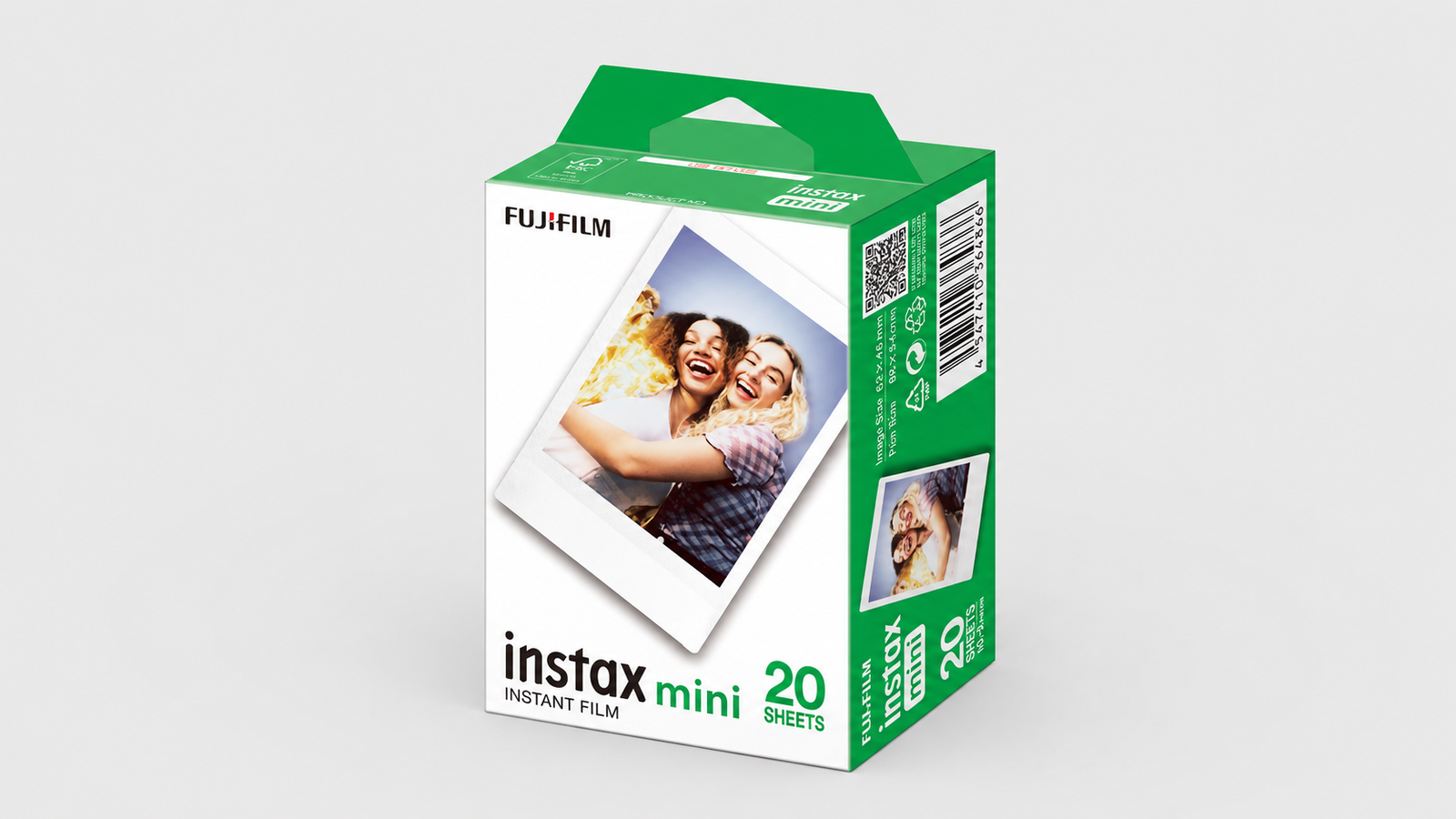
| Quick answerInstax Mini film is Fujifilm’s credit-card-size instant film format. Each standard pack has 10 shots, the film measures 54 x 86 mm, the picture area is 46 x 62 mm, and current Mini film works across Instax Mini cameras and compatible Mini printers. In 2026, the format is getting fresh attention because Fujifilm launched the Mini 13 and a new Pastel Galaxy film design while also expanding Instax film production. |
Instax Mini film has become one of the easiest ways to get a physical photo seconds after pressing the shutter. It is small, simple to carry, widely supported by Instax Mini cameras, and available in both classic white-frame packs and decorative designs. But buyers still have practical questions: Which cameras take it? How large is the actual image? Does old film still work? And what changed in 2026?
This guide answers those questions using Fujifilm specifications and current 2026 announcements, then adds common user concerns seen in the Instax community. Community posts are treated as anecdotal experience, not as a replacement for manufacturer instructions.
Instax Mini Film Quick Facts
| Specification | Instax Mini film |
|---|---|
| Film size | 54 x 86 mm (2.13 x 3.39 in) |
| Picture area | 46 x 62 mm (1.81 x 2.44 in) |
| Shots per standard pack | 10 prints |
| Film speed | ISO 800 |
| Typical development time | About 90 seconds; temperature can affect timing |
| Finish | Glossy |
| Compatibility | Instax Mini-format cameras and compatible Mini printers |
| 2026 update | Pastel Galaxy film introduced alongside the Instax Mini 13 |
Specs: Fujifilm Instax Mini film pages and official data sheet.
What Is Instax Mini Film?
Instax Mini is an integral instant film. The photographic layers and development chemistry are built into each sheet, so the image develops inside the print after it leaves the camera or printer. You do not need ink cartridges for an analog Instax Mini camera. The film itself is the photo material.
The biggest reason the format stays popular is convenience. A Mini print is close to credit-card size, which makes it easy to carry in a wallet, journal, scrapbook or small album. The actual picture area is smaller than the full sheet because the familiar white or decorative border surrounds the image.
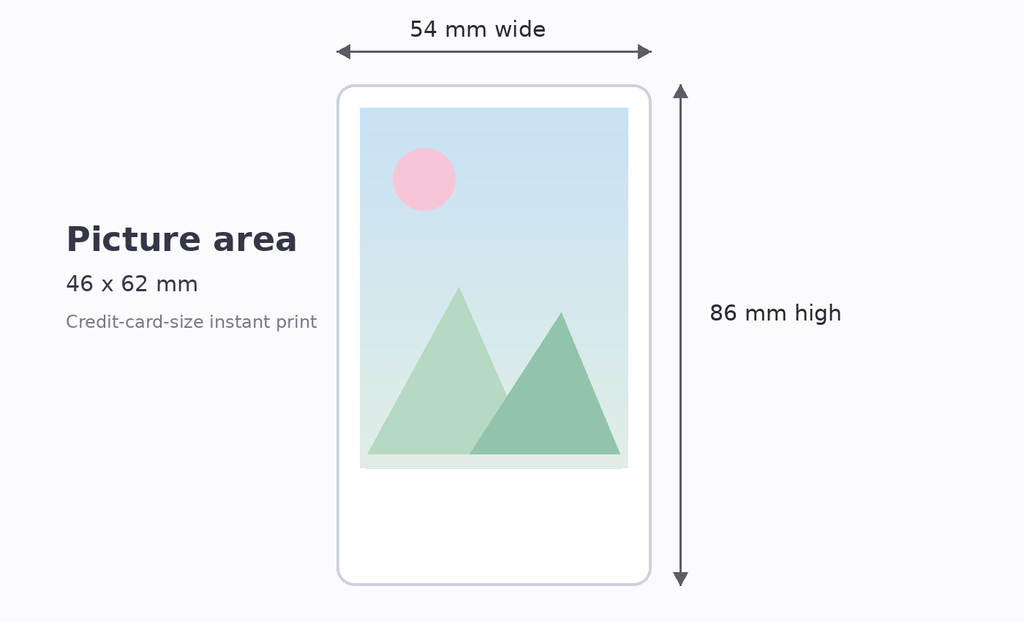
Original size diagram based on Fujifilm specifications.
Why Instax Mini Film Is Getting Fresh Attention in 2026
In March 2026, Fujifilm announced the Instax Mini 13 and introduced a new Mini-format film design called Pastel Galaxy. The film uses purple, blue and green decorative borders with clouds and stars, giving users another option beyond the standard white frame.
The film format is also supported by a broader demand story. In December 2025, Fujifilm announced a 5 billion JPY investment to expand Instax film production and said the new facilities were expected to lift production capacity by about 10% versus FY2025 once fully operational. That does not mean every pack will always be easy to find, but it shows Fujifilm is still investing in the instant-film category.
Which Cameras Use Instax Mini Film?
The simplest rule is to match the format name. If the camera or printer is an Instax Mini model, it uses Mini-format film unless the product documentation says otherwise. That includes current and older Mini cameras, which is useful for people buying a used Mini 8, Mini 9, Mini 11 or similar model.
A recent August 2026 discussion in the r/instax community shows this is still a common beginner question. Users were asking whether current Mini film works in an older Mini 11. The practical answer matches Fujifilm’s format system: use film labeled Instax Mini for a Mini-format camera. Always check the exact camera manual if you are unsure.
Common Mini-format devices include:
- Instax Mini 13, Mini 12, Mini 11 and older Mini analog cameras
- Instax Mini 99 and other Mini-format creative analog models
- Instax Mini Evo and Mini LiPlay hybrid cameras
- Instax Mini Link-series smartphone printers
How Does Instax Mini Film Develop?
When a shot is taken, the camera exposes the film. As the sheet is ejected, the built-in chemistry spreads through the layers and the image gradually appears. Fujifilm lists a typical development time of about 90 seconds, although temperature can change how quickly the image settles.
That is why there is no need to shake the print. A better habit is to let it develop naturally and avoid bending, squeezing or pressing the image area while the chemistry is working.
How Many Photos Are in a Pack?
A standard Instax Mini cartridge contains 10 sheets. Retailers also sell multi-packs that bundle several 10-shot cartridges together. For value comparisons, the most useful number is cost per shot rather than the headline pack price.
| Cost per shot = total pack price / total number of prints |
Prices vary by country, retailer, frame design and pack size, so avoid judging a deal only by the box price. Decorative frame editions can also cost more than standard white-frame film.
How to Store and Handle Instax Mini Film
Instant film is sensitive to heat, cold, pressure and light before use. Fujifilm’s technical guidance says not to load film in direct sunlight, not to press on the film pack, and to let a camera or film pack return to a normal temperature after it has been left in very hot or very cold conditions.
A few simple habits help reduce wasted shots:
- Keep unopened film in a cool, dry place and follow the storage guidance printed on the pack.
- Load the cartridge away from direct sunlight and align the camera’s film-loading marks correctly.
- After loading, keep the film door closed until the pack is finished. Opening it early can expose the remaining sheets to light.
- Do not squeeze, bend or press a fresh print while it is developing.
- Check the exposure counter before opening the camera so you know whether film is still inside.
Can Expired Instax Mini Film Still Work?
Sometimes, yes – but it is a gamble. The date on the pack matters, but storage history matters too. Film kept in stable conditions may remain usable after its date, while film stored in heat or poor conditions can show faded color, lower contrast, uneven development or other defects.
Recent 2026 Reddit discussions about expired Instax film include people reporting both good and bad results from old packs. That is useful as community experience, but it is not a guarantee. For important events, fresh in-date film is the safer choice.
Common Instax Mini Film Mistakes That Waste Shots
The film is simple, but a few beginner mistakes can turn an expensive 10-shot pack into a frustrating experience.
| Mistake | Why it matters |
| Opening the film door too early | If film is still inside, opening the back can expose sheets to light. |
| Using the wrong format | Mini, Square and Wide are different sizes and are not interchangeable. |
| Covering the flash or exposure sensors | On many analog Mini cameras, this can lead to poor exposure. |
| Forgetting the dark slide | The first ejected sheet after loading is the protective cover, not one of your photos. |
| Ignoring the film counter | Check the remaining-shot indicator before opening the back or planning a shoot. |
For a practical visual checklist, see this popular Instax Mini mistakes tutorial on YouTube. It is a community tutorial, not official Fujifilm documentation.
Instax Mini vs Square vs Wide
Instax Mini is only one of Fujifilm’s instant-film formats. The formats are not interchangeable, and each is aimed at a different style of shooting.
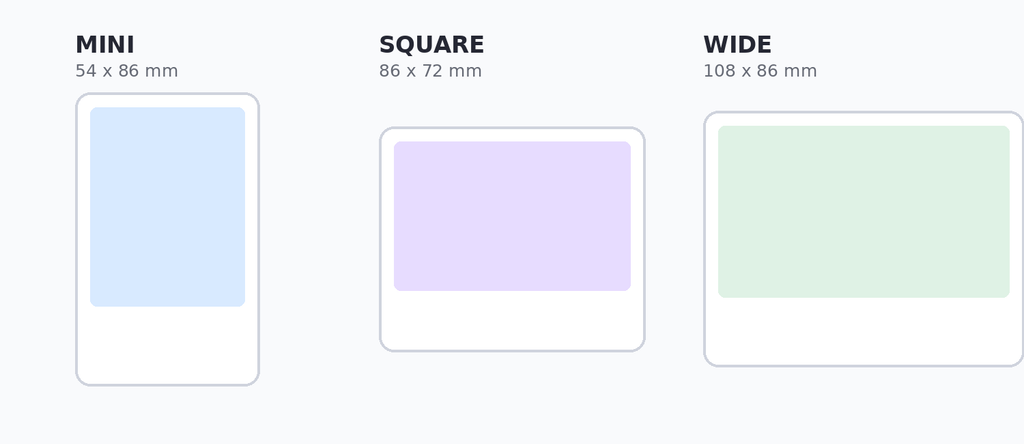
Format-size comparison for orientation. Always buy the film format printed on your camera or printer.
| Format | Film size | Best for | Trade-off |
| Mini | 54 x 86 mm | Everyday carry, journaling, parties | Smallest image area |
| Square | 86 x 72 mm | Balanced square compositions | Larger camera/film than Mini |
| Wide | 108 x 86 mm | Groups, landscapes, larger prints | Bulkiest format |
Is Instax Mini Film Worth It in 2026?
For people who want small physical photos immediately, Instax Mini remains an easy format to recommend. The ecosystem is mature, the film works across many generations of Mini cameras, and Fujifilm is still releasing new cameras and frame designs. The trade-off is ongoing film cost: every shutter press uses one sheet, so learning to frame carefully matters.
It makes the most sense for parties, travel journals, gifts, memory books and people who enjoy the look and ritual of instant photography. If your priority is unlimited shooting at the lowest cost, a digital camera or phone is more economical. Instax is about the physical print experience, not cost-per-image efficiency.
Frequently Asked Questions
What size is Instax Mini film?
The full film sheet is 54 x 86 mm, while the picture area is 46 x 62 mm.
How many pictures do you get in one Instax Mini pack?
A standard cartridge contains 10 prints. Multi-packs simply bundle multiple cartridges.
Does new Instax Mini film work in older Mini cameras?
Generally yes, as long as the camera is designed for the Instax Mini format. Check the exact model manual if you are unsure.
How long does Instax Mini film take to develop?
Fujifilm lists about 90 seconds under typical conditions, although temperature can affect development.
Should you shake an Instax Mini photo?
No. Let the print develop naturally and avoid bending or pressing it.
Can Instax Mini film expire?
Yes. Expired film may still produce images, but color, contrast and development can become less predictable, especially if storage conditions were poor.
What is new for Instax Mini film in 2026?
Fujifilm introduced the Pastel Galaxy Mini film design alongside the Instax Mini 13 and continued expanding film-production capacital